The NMC advertising guidelines, in your questions
This FAQ helps you understand the new NMC notice by breaking it down into bite sized FAQs which you can consume and easily understand.
Note: Many points are not clearly set to allow or disallow - in such cases, a risk scale has been indicated per RAiZEN's read.
Tap a question to open it. Each answer shows the notice's exact words. Where a risk level rests on RAiZEN's reading rather than the notice's words, it says so. This is not legal advice.
See the sources used to prepare this
Source: Guidelines on Ethical Advertising and Public Communication by Hospitals/Medical Institutions and Registered Medical Practitioners. National Medical Commission, No. R-13014/01/2024-Ethics, dated 6 October 2026. Read the notice on nmc.org.in
Prepared by: RAiZEN. Experienced in reading, understanding and implementing government regulations in unicorn startups.
Last reviewed: 11 October 2026
Scope: This notice only, for registered medical practitioners. Not legal advice.
Corrections: Tell RAiZEN: Contact now
Topic: all
No question matches. Try another word, or show all questions.
The basicsDoes this notice apply to me, and from when?
Yes, if you are on a medical register, from 6 October 2026. Live older posts count, on RAiZEN's reading.
Does this notice apply to me, and from when?
- The notice's definitions cover every doctor on the national register or a state medical register; its scope is your advertising and digital communication, read with the 2002 code of medical ethics.
- It comes into force on publication (the cover page says "with immediate effect"), and the NMC may clarify it later.
- On RAiZEN's reading, a post that is still live is still being published, so treat it as covered.
The notice's exact words
PUBLIC NOTICE
The Guidelines shall come into force with immediate effect.
1.Short Title and Commencement
1.2 They shall come into force on the date of their publication by the National Medical Commission.
3.Definitions
3.7 “Registered Medical Practitioners” or “RMP(s)” shall mean and include the Medical Practitioners registered under the NMC Act and whose names are either entered in the National Register under section 31 of the NMC Act or in the concerned State Medical Register.
4.Scope & Applicability
4.1 These Guidelines shall apply to the professional conduct of the RMPs in relation to advertising, publicity, digital communication and promotional activities and to address the gap created due to advent of electronic media. These Guidelines are sought to be more comprehensive, specific and aligned to the needs of the present-day society.
4.2 In relation to RMPs, these Guidelines shall be read with the IMC (Professional Conduct, Etiquette and Ethics) Regulations, 2002, as amended from time to time, and the NMC Act, 2019. In case of any irreconcilable conflict, the applicable statutory provisions and operative regulations shall prevail.
12.Power to Issue Clarifications
The National Medical Commission may issue such clarifications, advisories, standard operating procedures or procedural instructions, consistent with these Guidelines and the National Medical Commission Act, 2019, as may be necessary for their effective and uniform implementation.
Next, read these
The basicsIs my own website or Instagram page "advertising" under the notice?
Yes, when it promotes you. Plain public information with no promotional intent is exempt.
Is my own website or Instagram page "advertising" under the notice?
- The notice's definitions count any communication, in any medium, that promotes your services, skills, qualifications or reputation.
- The notice names websites, blogs, social media, WhatsApp, podcasts and interviews.
- Information for the public with no promotional intent and no commercial aim is exempt.
The notice's exact words
3.Definitions
3.2 "Advertisement” mean any form of communication, promotion, publicity, announcement, representation or dissemination of information in any medium, which directly or indirectly solicits, promotes or is intended to promote the professional services, reputation, skills, qualifications, achievements, facilities or commercial healthcare services of an RMP or hospital/medical institution.
For the purposes of these Guidelines, digital, social-media, sponsored, targeted, influencer-led, search-engine, platform-based, audio-visual, AI-generated or AI-assisted promotional communications shall be treated as advertising where their content or manner of dissemination has a promotional character.
Explanation I - The discourse of information in the normal course of discharge of information to the public at large, without same being promotional and without any intent for commercial benefit shall be exempted from the above definition of “Advertisement”.
3.5 “Medium of advertisement” means and includes but is not limited to print media, Television, Radio, Social media platforms, websites and blogs, messaging platforms (WhatsApp, Telegrams, Facebook etc.),Podcasts, Influencer marketing, Digital marketing campaigns, sponsored posts, artificial intelligence generated promotion, public interviews, news articles intended for promotion, online healthcare platforms, any audio-visual or digital communication by whatsoever name called.
RAiZEN reads your public pages against this notice and tells you what it found. It does not certify compliance. To start, send just your website address, never patient records.
Next, read these
What happens ifWhat happens if I break the rules?
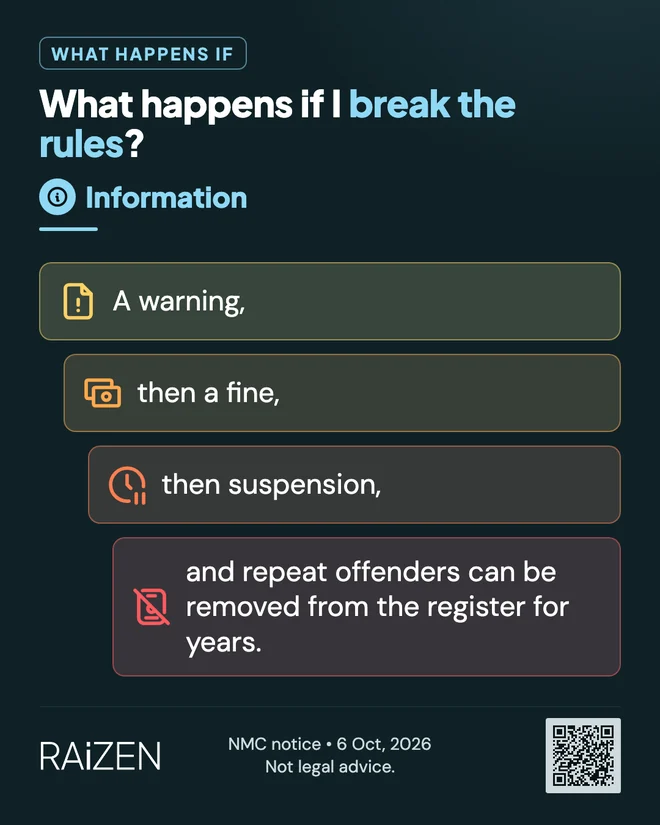
A warning, then a fine, then suspension, and repeat offenders can be removed from the register for years.
What happens if I break the rules?
- Your state medical council acts first: a show-cause notice, your explanation, then a reasoned order.
- The notice sets the ladder:
- a warning and ethics training for a first violation.
- censure and a fine for a second.
- 3 to 6 months' suspension for a third.
- 6 to 12 months for a serious one (misleading cure claims, inducing patients, digital mass solicitation).
- removal from the register for 1 to 3 years for repeated violations.
- You can appeal to the NMC's Ethics and Medical Registration Board within 60 days, and once more after that.
The notice's exact words
10.Penalties / Corrective Measures
10.1 In case of violation of the above guidelines, actions will be taken by the concerned SMC against the erring RMP in accordance with the provisions ofthe NMC Act and Regulations made thereunder.The following graded action may be contemplated by the SMC concerned;
i. First Violation: Warning and mandatory ethics training.
ii. Second Violation: Censure and monetary penalty.
iii. Third Violation: Suspension of registration (3-6 months).
iv. Serious Violation (Misleading cure claims, inducement for patients, digital mass solicitation, etc.) Suspension of 6-12 months.
v. Repeated Violations: Removal from medical register for 1-3 years.
Any violation of these Guidelines by an RMP may, where applicable, constitute professional or ethical misconduct and shall be dealt with by the competent authority in accordance with the NMC Act, 2019, the applicable Ethics Regulations and the principles of natural justice.
The competent authority may, where legally permissible, impose such disciplinary or corrective measures, including censure, direction for corrective compliance/ethics sensitization, restriction or suspension of registration, removal from the register for a specified period or otherwise, and monetary penalty, as may be authorized under the NMC Act and applicable Regulations.
10.2 The penalties shall be imposed only after issuing a show-cause notice to the defaulting RMP and providing an opportunity to explain or clarify the alleged violation, in accordance with the applicable laws.
10.3 Where an RMP is found to be in violation of these Guidelines, the SMC shall issue a reasoned and speaking order setting out:
i. the specific violation identified;
ii. the contentions of the defaulting RMP/ and reasons for acceptance / rejection of the same;
iii. the reasons and basis for imposing the penalties.
11.Appellate Mechanism
11.1 Any RMP aggrieved by the findings or decision of the SMC may prefer an appeal before the Appellate Authority i.e, EMRB,NMC, within 60 days under Section 30 (3) of NMC Act, 2019.
11.2 The Appellate Authority shall independently examine the appeal and may, where considered necessary, call for the records and direct a fresh assessment, seek additional opinion, or undertake such further examination as it deems fit in accordance with these Guidelines.
11.3 The Appellate Authority shall pass a reasoned and speaking order, clearlyrecording the basis for affirming, modifying, or setting aside the findings of the SMC.
11.4 The decision on the first appeal may be contested by the RMP through second appeal, in accordance with Section 30 (4), NMC Act, 2019, within sixty days of communication of such decision.
Next, read these
Patients and reviewsCan I ask patients for reviews?
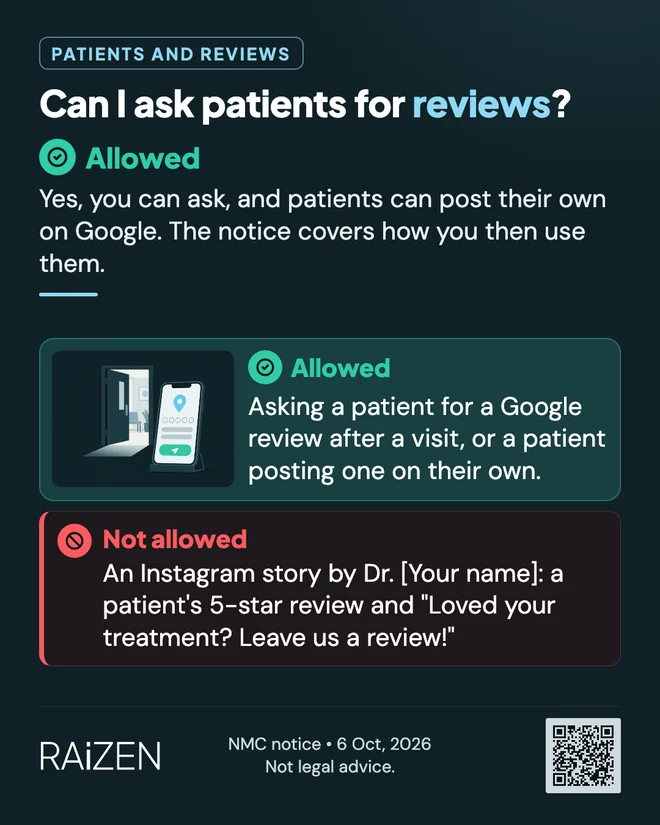
Yes, you can ask, and patients can post their own on Google. The notice covers how you then use them.
Can I ask patients for reviews?
- The notice's definitions say a doctor shall not request or share patient reviews for professional promotion on social media.
- On RAiZEN's reading, asking a patient for a review, and a patient posting one on Google on their own, is not promotion on social media.
- What you then do with the review is what the notice covers: see the answer on Google reviews on your website.
Risk scale
The example the rows refer to: An Instagram story by Dr. [Your name]: a patient's 5-star review and "Loved your treatment? Leave us a review!"
The example above, or your Google rating badge on your Instagram.
Requesting and sharing reviews on social media are both named in the notice.
The notice's own words, Explanation V
Asking a patient for a Google review after a visit, or a patient posting one on their own.
Asking is not promotion on social media, and a patient's own post is theirs. How you then use the review is what the notice covers.
RAiZEN's reading of Explanation V
Not rated yet: Very high risk, High risk, Medium risk, Low risk.
The notice's exact words
3.Definitions
Explanation V- No RMP or hospital/medical institution shall solicit, purchase, procure, manipulate or cause to be published fake, paid or misleading patient reviews, ratings, testimonials, endorsements or recommendations for the promotion of medical services. An RMP shall not request or share patient testimonials, recommendations, endorsements or reviews for professional promotion on social media.
3.6 “Social Media” shall mean and include all forms of publications and sharing through internet-based websites, apps, etc. by whatsoever name called, which allows users to create, share and join online communities, participate in social networking, etc.
Next, read these
Patients and reviewsCan I share a patient's success story if they consent?
No, even with the patient's consent. Consent does not make a testimonial or success story allowed.
Can I share a patient's success story if they consent?
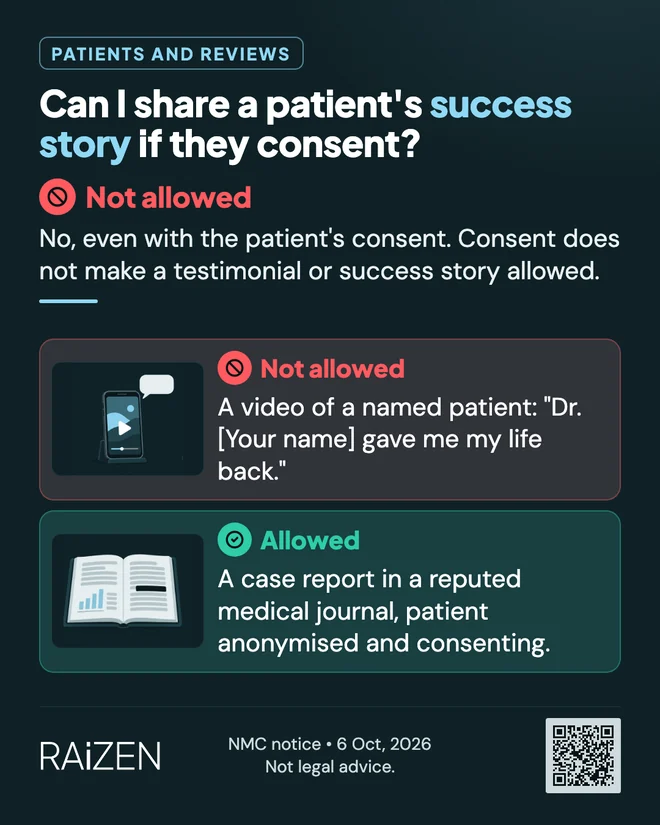
- The notice's privacy rules say consent does not, by itself, make a testimonial, success story or before-and-after allowed.
- The rules for doctors bar promoting success stories unless strictly scientific or educational, with the patient anonymised and consenting.
Risk scale
The example the rows refer to: A video of a named patient: "Dr. [Your name] gave me my life back."
The example above, on your website or Instagram.
A named patient promoting you. Consent does not change that.
The notice's own words, clauses 6.2 and 8.1(v)
Your hospital's patient-story video, embedded on your website.
The hospital made it, but showing it on your page makes it your promotion.
RAiZEN's reading of clause 8.1(v)
A plain link to your hospital's video channel.
Points patients elsewhere without featuring any one story.
RAiZEN's reading
A short case explainer cut from the footage: the condition and the procedure, patient not identifiable.
Education built from a real case, with no face, name or testimonial.
RAiZEN's reading of clause 8.1(v)
A case report in a reputed medical journal, patient anonymised and consenting.
This is the route the notice allows.
RAiZEN's reading of clauses 8.1(v) and 8.2(i)
Not rated yet: High risk.
The notice's exact words
6.Patient Privacy and Consent
6.2 Patient consent shall not, by itself, make permissible any testimonial, endorsement, promotional patient story, before-and-after depiction, success claim or other advertising practice that is otherwise prohibited under these Guidelines or applicable law.
8.1 Advertising Restrictions and Permitted Communications for RMPs.
v. Shall not publish cases for promotional purposes, advertise surgical results, display “before and after” photographs, publicize celebrity patients, promote personal success stories unless published strictly for scientific or educational purposes with anonymized patient consent.
8.2 Exceptions from Prohibitions for RMP –
i. Only research-based communication, wherein they have published interesting case studies in reputed medical journals shall be allowed.
Next, read these
Patients and reviewsCan I show patients' Google reviews on my website?
Yes, on RAiZEN's reading: genuine, shown whole and linked. Each review carries risk by what it says.
Can I show patients' Google reviews on my website?
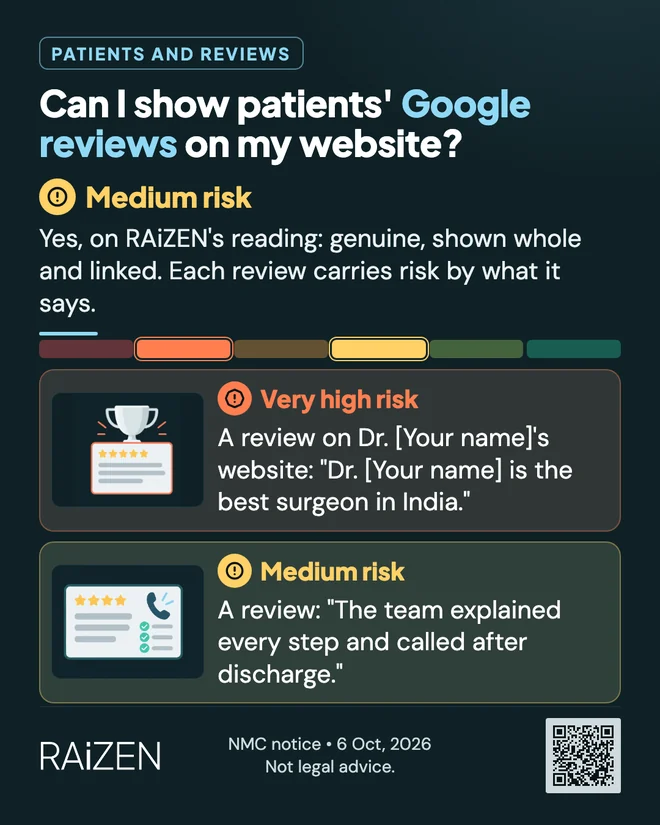
- The notice bars fake, paid or misleading reviews and patients promoting you through prohibited testimonials.
- It says nothing direct about genuine reviews on your own website, so showing them, and the scale below, are RAiZEN's reading.
Risk scale
The example the rows refer to: A review on Dr. [Your name]'s website: "Dr. [Your name] is the best surgeon in India."
Reviews you wrote yourself, or paid patients to post. See Can I buy followers, likes or reviews?
The example above: a patient calling you the best.
On your site, a patient's "best" does the work your own "best" cannot.
RAiZEN's reading of clause 8.1(iii)
A review saying "I felt no pain at all". See Can I say a treatment is "pain-free"?
A review: "The team explained every step and called after discharge."
About care, not results. Show it whole, with a link to the original.
RAiZEN's reading
Not rated yet: Low risk, Allowed.
The notice's exact words
3.Definitions
Explanation V- No RMP or hospital/medical institution shall solicit, purchase, procure, manipulate or cause to be published fake, paid or misleading patient reviews, ratings, testimonials, endorsements or recommendations for the promotion of medical services. An RMP shall not request or share patient testimonials, recommendations, endorsements or reviews for professional promotion on social media.
8.1 Advertising Restrictions and Permitted Communications for RMPs.
xi. No RMP shall use or permit any celebrity, influencer, patient, employee or third party to promote professional services through prohibited testimonials, endorsements or recommendations. Any material commercial relationship in lawful public-health or informational communication shall be transparently disclosed in accordance with applicable law. No RMP or hospital/medical institution shall use a third party as an intermediary to do indirectly what the RMP or institution is prohibited from doing directly.
Next, read these
Photos and videosCan I post before-and-after photos?
No, even with consent. Only for teaching or science, anonymised, with the patient's consent.
Can I post before-and-after photos?
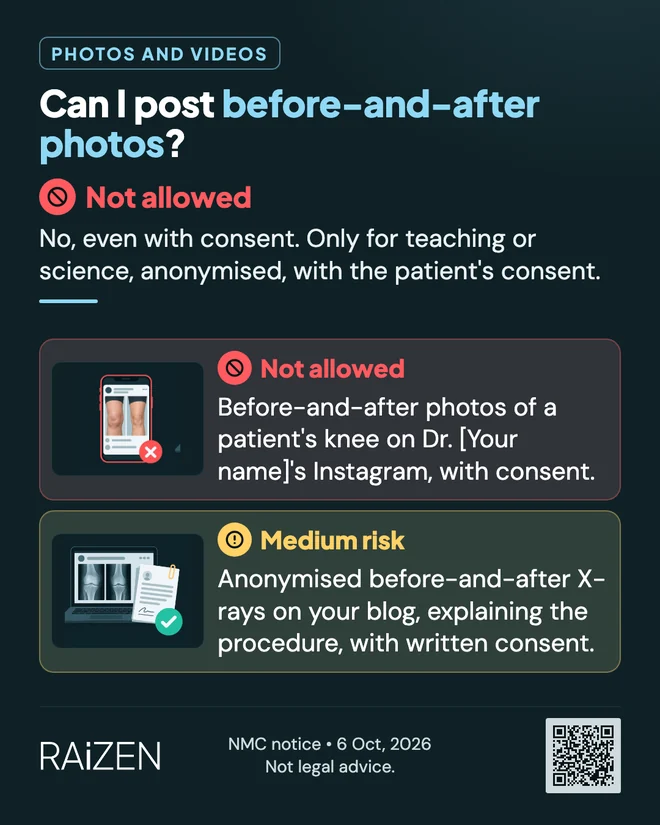
- The notice's rules for doctors name before-and-after photographs.
- Consent alone does not make a before-and-after depiction allowed.
Risk scale
The example the rows refer to: Before-and-after photos of a patient's knee on Dr. [Your name]'s Instagram, with consent.
The example above.
Before-and-after photos are named in the clause. Consent does not change that.
The notice's own words, clauses 8.1(v) and 6.2
Anonymised before-and-after X-rays on your blog, explaining the procedure, with written consent.
The notice allows strictly educational use. On your own site it can still read as showing off results.
RAiZEN's reading of clause 8.1(v)
The same images in a case report in a reputed medical journal. See Can I share a patient's success story if they consent?
Not rated yet: Very high risk, High risk, Low risk.
The notice's exact words
6.Patient Privacy and Consent
6.2 Patient consent shall not, by itself, make permissible any testimonial, endorsement, promotional patient story, before-and-after depiction, success claim or other advertising practice that is otherwise prohibited under these Guidelines or applicable law.
8.1 Advertising Restrictions and Permitted Communications for RMPs.
v. Shall not publish cases for promotional purposes, advertise surgical results, display “before and after” photographs, publicize celebrity patients, promote personal success stories unless published strictly for scientific or educational purposes with anonymized patient consent.
8.2 Exceptions from Prohibitions for RMP –
i. Only research-based communication, wherein they have published interesting case studies in reputed medical journals shall be allowed.
Next, read these
Talking about yourselfCan I use the word "best" on my website?
No, you cannot use "best" about yourself. If you are still planning to use it, understand the risk scale.
Can I use the word "best" on my website?
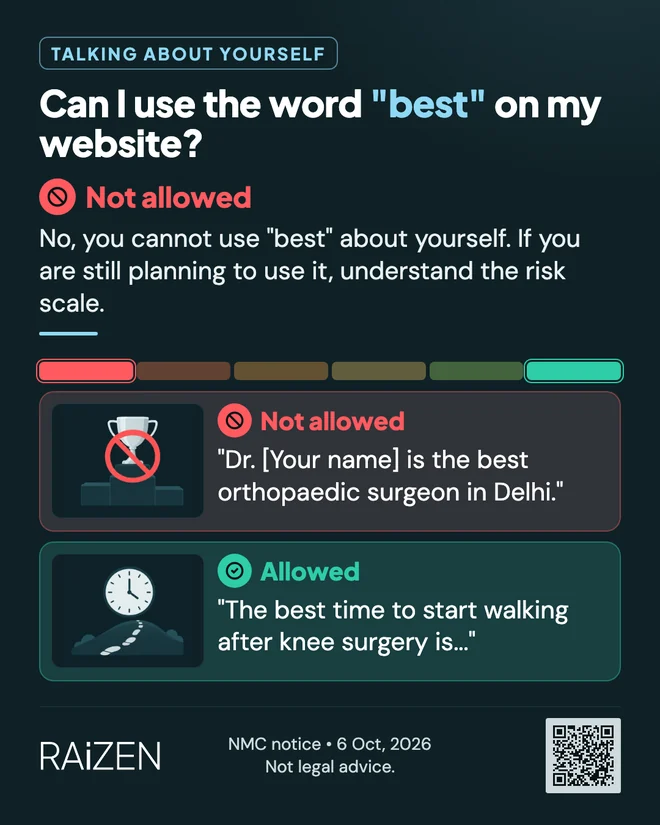
- The notice's rules for doctors name self-praise like "No.1 Specialist": said bare, it is not allowed, and with a verified, disclosed award or ranking it is high risk, the same as "best".
- On RAiZEN's reading, any "best" about yourself must at least be checkable by anyone, with the method shown.
- Even then it stays high risk.
Risk scale
The example the rows refer to: "Dr. [Your name] is the best orthopaedic surgeon in Delhi."
The example above, or any "best" about yourself that nobody can check.
The notice bans self-praise like "No.1 Specialist" by name. "Best" about yourself is the same claim.
The notice's own words, clause 8.1(iii)
"Winner, Best Orthopaedic Surgeon Award", with no name of who gave it, no year, no method.
If leaving those out could mislead a patient, the notice says show them.
RAiZEN's reading
The same award, with who gave it, the year and the method, checkable by anyone.
The notice's only way to use "best". RAiZEN knows of no ruling on this route under the new notice, as of 10 October 2026.
RAiZEN's reading
A "how to choose a knee surgeon" guide that matches your own degrees to its checklist.
Matching your degrees to the checklist turns the guide into an ad for you. It can rate higher.
RAiZEN's reading
A guide opening "If you are searching for the best knee surgeon in Delhi, here is what to check".
It names no doctor. Keep the signs general and link only to plain facts.
RAiZEN's reading
"The best time to start walking after knee surgery is..."
Recovery advice. It makes no claim about any doctor.
No rule covers it (RAiZEN's reading)
The notice's exact words
8.1 Advertising Restrictions and Permitted Communications for RMPs.
iii. Shall not advertise either personal achievements or professional success rates or number of patients treated with illustrative assertions such as
or any other unverifiable or exaggerated claims by whatsoever name called.
ix. No RMP or hospital/medical institution shall make comparative claims such as
or similar superiority claims unless the claim is objectively verifiable, based on a transparent and independently ascertainable methodology and is otherwise permissible under applicable law.
Provided, Any ranking or award relied upon in advertising shall be capable of independent verification, and material conditions, methodology and relevant date, details of award giving organization or firm shall be disclosed where necessary to avoid misleading the public.
Next, read these
Talking about yourselfCan I call myself "leading", "top" or "most trusted"?
No, not as a bare claim. Without an award or ranking anyone can check, it carries high risk.
Can I call myself "leading", "top" or "most trusted"?
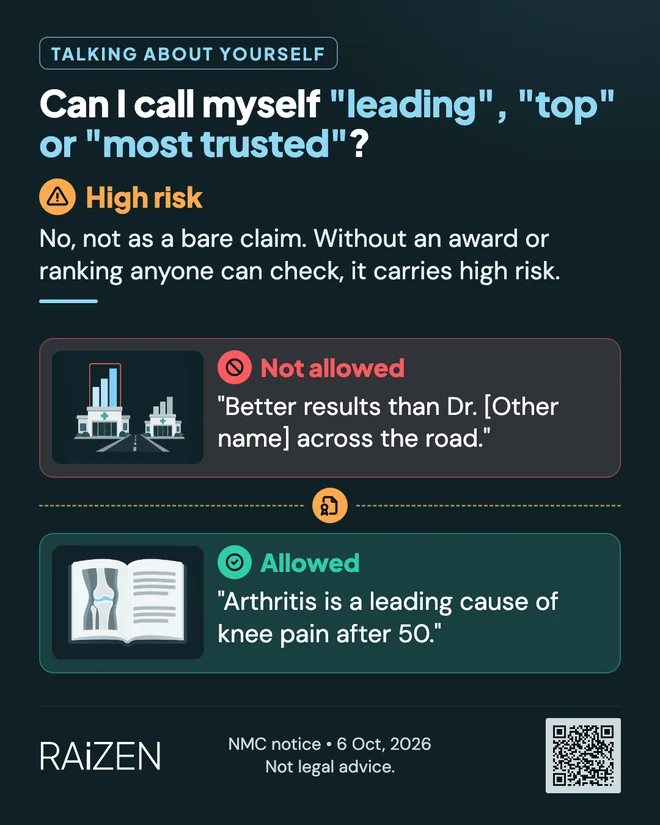
- The notice's rules for doctors bar words like "leading", "top" and "most trusted" unless the claim can be checked independently, with the method shown.
- Any award or ranking you rely on must say who gave it, when, and how.
Risk scale
The example the rows refer to: "Dr. [Your name], the leading knee surgeon in [your city]."
"Better results than Dr. [Other name] across the road."
A claim against another doctor by name. No method can make that checkable.
RAiZEN's reading of clause 8.1(ix)
The example above, with no award or method behind it.
The word is named in the notice, and nobody can check it.
RAiZEN's reading of clause 8.1(ix)
"Ranked among the top 10 knee surgeons in [your city], [named survey], 2025", with its method linked.
Checkable, with who ranked you, when and how. RAiZEN knows of no ruling on this route under the new notice, as of 10 October 2026.
RAiZEN's reading of clause 8.1(ix)
"Arthritis is a leading cause of knee pain after 50."
The word describes a disease, not you.
No rule covers it (RAiZEN's reading)
Not rated yet: Very high risk, Low risk.
The notice's exact words
8.1 Advertising Restrictions and Permitted Communications for RMPs.
ix. No RMP or hospital/medical institution shall make comparative claims such as
or similar superiority claims unless the claim is objectively verifiable, based on a transparent and independently ascertainable methodology and is otherwise permissible under applicable law.
Provided, Any ranking or award relied upon in advertising shall be capable of independent verification, and material conditions, methodology and relevant date, details of award giving organization or firm shall be disclosed where necessary to avoid misleading the public.
Next, read these
Promises about resultsCan I say a treatment is "pain-free"?
No. The notice bans "painless treatment" by name, and "pain-free" promises the same thing.
Can I say a treatment is "pain-free"?
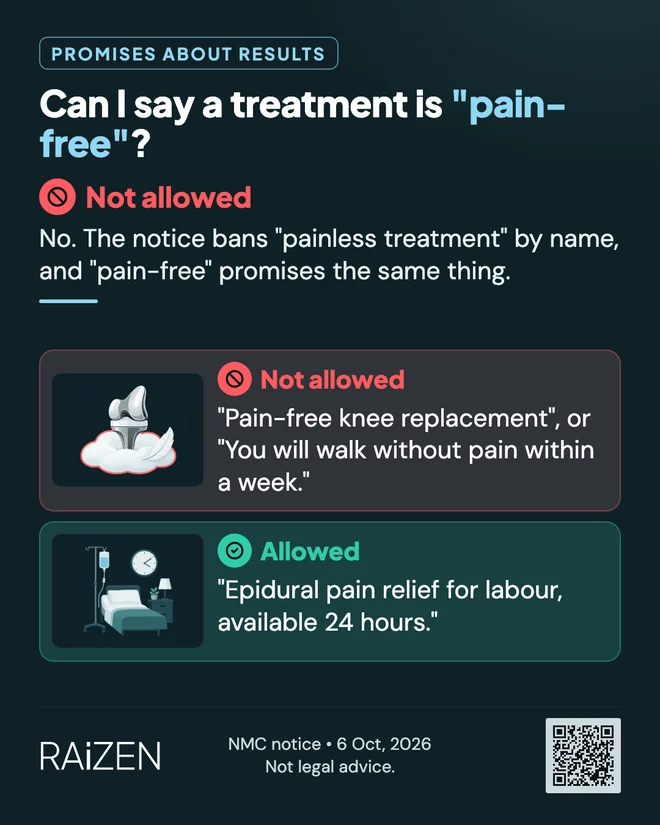
- The notice's rules for doctors bar promises of results and statements that set unrealistic expectations.
- A patient's own words about pain sit lower on the scale than yours.
Risk scale
The example the rows refer to: "Pain-free knee replacement with Dr. [Your name]."
"Pain-free knee replacement", or "You will walk without pain within a week."
Both say the procedure or the recovery will be painless. The notice names "painless treatment".
RAiZEN's reading of clause 8.1(iii)
A patient's Google review on your site, shown in full: "I felt no pain at all."
Their words, but on your site it still reads as a no-pain claim.
RAiZEN's reading
A patient's review: "My knee pain is gone."
Relief after treatment, in the patient's words, linked to the original review.
RAiZEN's reading
"Epidural pain relief for labour, available 24 hours."
Names the service and when it runs. It promises no outcome.
No rule covers it (RAiZEN's reading)
Not rated yet: Very high risk, Low risk.
The notice's exact words
8.1 Advertising Restrictions and Permitted Communications for RMPs.
iii. Shall not advertise either personal achievements or professional success rates or number of patients treated with illustrative assertions such as
or any other unverifiable or exaggerated claims by whatsoever name called.
vi. Shall not publish any statement that creates unrealistic expectations, misrepresents treatment outcomes, conceals risks, promote unproven therapies, secret remedy or treatment whose composition, scientific basis, safety or efficacy is not adequately established or which is otherwise prohibited under applicable law.
Next, read these
Promises about resultsCan I say "guaranteed results" or "permanent cure"?
No. The notice names "Guaranteed cures", "Miracle treatment" and "Exclusive cure" as claims you cannot make.
Can I say "guaranteed results" or "permanent cure"?
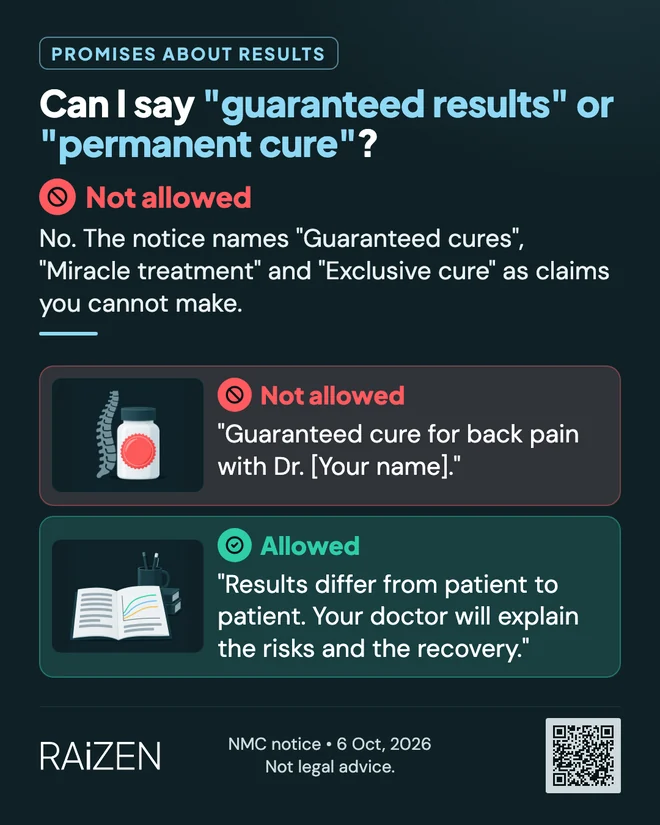
- The notice's rules for doctors list these phrases by name.
- No statement may create unrealistic expectations or misrepresent outcomes.
- Misleading cure claims are listed as a serious violation.
Risk scale
The example the rows refer to: "Guaranteed cure for back pain with Dr. [Your name]."
The example above, or "a miracle treatment for arthritis".
Both phrases are named in the notice, word for word.
The notice's own words, clause 8.1(iii)
"Permanent relief from knee pain after one procedure."
Different words, the same promise of a cure.
RAiZEN's reading of clauses 8.1(iii) and 8.1(vi)
"After knee replacement, the plan is to get you walking with support within a day, if your recovery allows."
The usual plan for the procedure, with its condition. No promise, and not your patients' results.
RAiZEN's reading of clauses 8.1(v) and 8.1(vi)
"Results differ from patient to patient. Your doctor will explain the risks and the recovery."
Sets honest expectations. That is what the clause asks for.
RAiZEN's reading of clause 8.1(vi)
Not rated yet: High risk, Medium risk.
The notice's exact words
8.1 Advertising Restrictions and Permitted Communications for RMPs.
iii. Shall not advertise either personal achievements or professional success rates or number of patients treated with illustrative assertions such as
or any other unverifiable or exaggerated claims by whatsoever name called.
vi. Shall not publish any statement that creates unrealistic expectations, misrepresents treatment outcomes, conceals risks, promote unproven therapies, secret remedy or treatment whose composition, scientific basis, safety or efficacy is not adequately established or which is otherwise prohibited under applicable law.
10.Penalties / Corrective Measures
iv. Serious Violation (Misleading cure claims, inducement for patients, digital mass solicitation, etc.) Suspension of 6-12 months.
Next, read these
Numbers and resultsCan I publish my success rate?
No. The notice bars advertising success rates. A paper in a medical journal is the allowed route.
Can I publish my success rate?
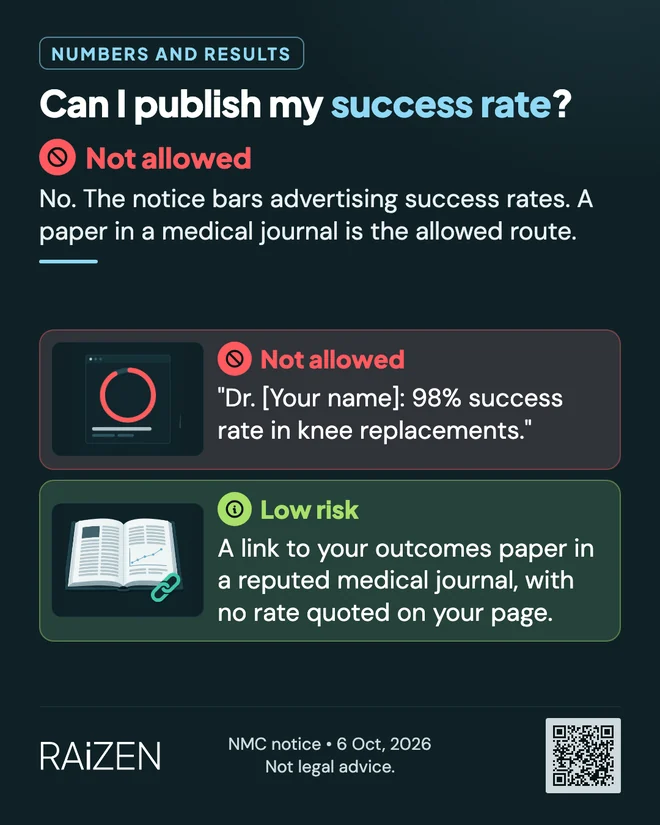
- The notice's rules for doctors bar advertising professional success rates, and name "100% success".
- Research-based communication published in reputed medical journals is allowed.
Risk scale
The example the rows refer to: "Dr. [Your name]: 98% success rate in knee replacements."
The example above.
Success rates are named in the clause, and "100% success" is its own banned phrase.
The notice's own words, clause 8.1(iii)
"9 out of 10 of my patients are back at work in six weeks."
The same success rate in other words. It promises a result.
RAiZEN's reading of clause 8.1(iii)
"Infection rates are under 1% in our practice", in a risk section.
Your own complication rate is your success rate turned around. Keep the risk on the page, without your own figure.
RAiZEN's reading of clauses 8.1(iii) and 8.1(vi)
A link to your outcomes paper in a reputed medical journal, with no rate quoted on your page.
Journal research is allowed. Pulling the rate into a headline would turn it back into an ad.
RAiZEN's reading of clause 8.2(i)
Not rated yet: Medium risk, Allowed.
The notice's exact words
8.1 Advertising Restrictions and Permitted Communications for RMPs.
iii. Shall not advertise either personal achievements or professional success rates or number of patients treated with illustrative assertions such as
or any other unverifiable or exaggerated claims by whatsoever name called.
8.2 Exceptions from Prohibitions for RMP –
i. Only research-based communication, wherein they have published interesting case studies in reputed medical journals shall be allowed.
Next, read these
Fees and offersCan I offer discounts, free consultations or a free camp?
No, not to pull patients in. Discounts, free consultations and camps used that way are inducements, a serious violation.
Can I offer discounts, free consultations or a free camp?
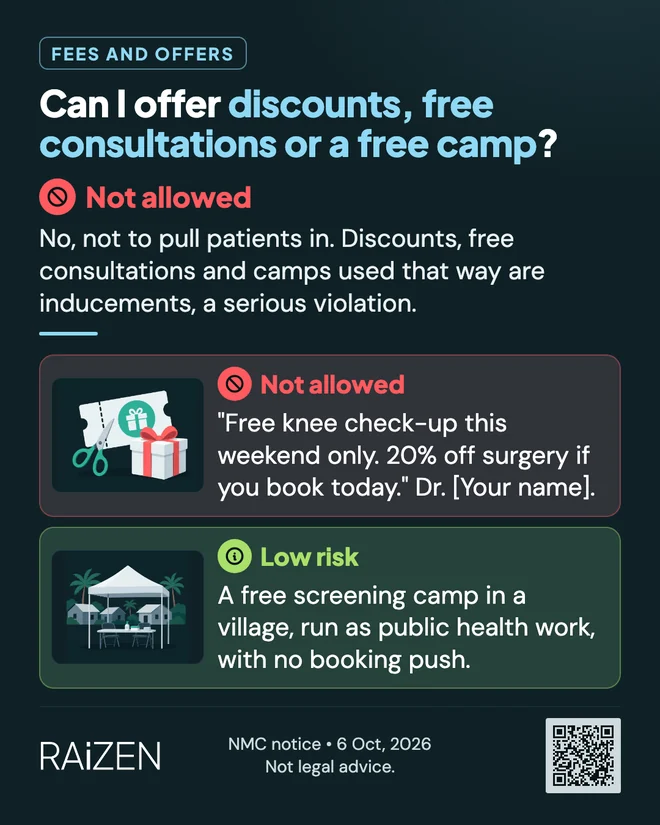
- The notice's rules for doctors bar discounts, limited-period offers, coupons, gifts, cashbacks, referral benefits and free procedures used in a way likely to drive unnecessary care or solicit patients.
- Inducement for patients is listed as serious.
Risk scale
The example the rows refer to: "Free knee check-up this weekend only. 20% off surgery if you book today." Dr. [Your name].
The example above.
The clause bars discounts and limited-period offers used to pull patients in. This one does that.
RAiZEN's reading of clauses 8.1(x) and 10.1(iv)
A free screening camp in a village, run as public health work, with no booking push.
Public health work is allowed if it does not promote your practice or solicit patients.
RAiZEN's reading of clause 5.1
Not rated yet: Very high risk, High risk, Medium risk, Allowed.
The notice's exact words
5.Public Awareness: Public health education
5.1 Medical Practitioners may participate in health awareness programmers, public health campaigns, academic discussions, educational content, provided that such activities do not promote personal practice, do not solicit patients and are not monetized through promotional marketing.
8.1 Advertising Restrictions and Permitted Communications for RMPs.
x. No RMP or hospital/medical institution shall use discounts, limited-period offers, contests, coupons, gifts, cashbacks, referral benefits, free procedures or similar inducements in a manner that is likely to encourage unnecessary medical consultation, diagnostic investigation or treatment or otherwise amounts to solicitation of patients.
Any lawful disclosure of charges, packages or fees shall be factual, transparent and not misleading.
10.Penalties / Corrective Measures
iv. Serious Violation (Misleading cure claims, inducement for patients, digital mass solicitation, etc.) Suspension of 6-12 months.
Next, read these
AI toolsCan I use AI to write or design my posts?
Yes, if the content follows the rules and is labelled as AI-made. Never for a promotional campaign.
Can I use AI to write or design my posts?
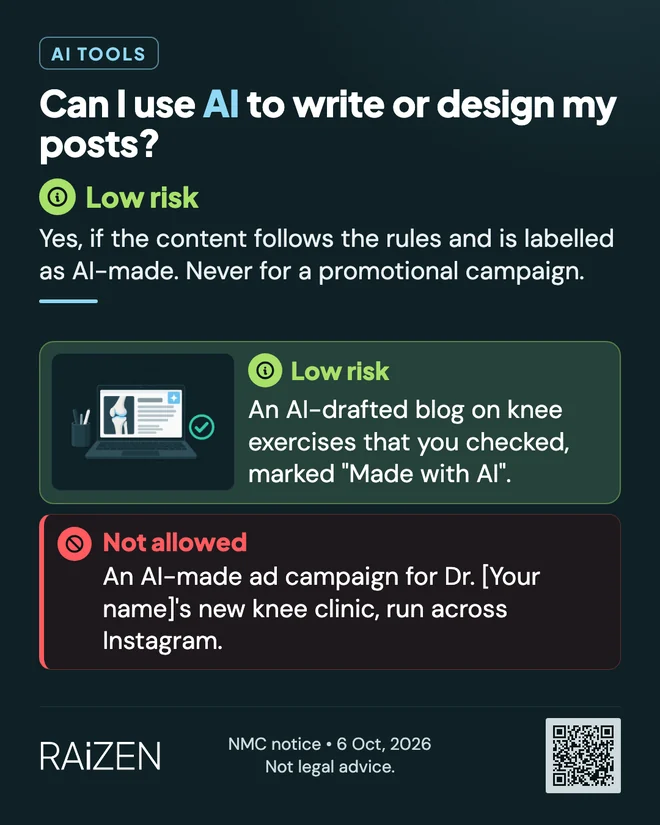
- The notice prohibits AI-generated promotional campaigns for commercial interest.
- AI content that follows the rules must carry a mark saying it comes from AI, and must not mislead about diagnosis, treatment, outcomes or qualifications.
Risk scale
The example the rows refer to: An AI-made ad campaign for Dr. [Your name]'s new knee clinic, run across Instagram.
The example above.
An AI-made promotional campaign for commercial gain is prohibited in so many words.
RAiZEN's reading of clause 7.2
An AI-drafted blog on knee exercises that you checked, marked "Made with AI".
Accurate, educational and carrying the AI mark the notice asks for.
RAiZEN's reading of clause 7.2
Not rated yet: Very high risk, High risk, Medium risk, Allowed.
The notice's exact words
7.Prohibited Advertising Practices for RMP / Clinical Establishments
7.2 AI Generated promotional campaign for furtherance of commercial interest is prohibited.Any AI generated promotional contentconforming to the provisions of these guidelines, the Regulations, and applicable Clinical Establishment Act and rules framed thereunder/ any other State Act as applicable, shall compulsorily carry the source mark, explicitly stating that the origin of the content is AI.
a) AI-generated or AI-assisted content shall not be used by an RMP or hospital/medical institution to create or disseminate misleading, deceptive or unverifiable representations concerning diagnosis, treatment, clinical outcomes, professional qualifications, patient experiences or healthcare services.
c) Where AI-generated or materially AI-altered content is used in a manner in which its artificial nature may reasonably be material to the audience's understanding of the communication, appropriate disclosure shall be made.
Next, read these
AI toolsCan I make AI videos of myself, or AI images of patients?
No to AI patients, testimonials or results. An AI version of yourself is not rated yet.
Can I make AI videos of myself, or AI images of patients?
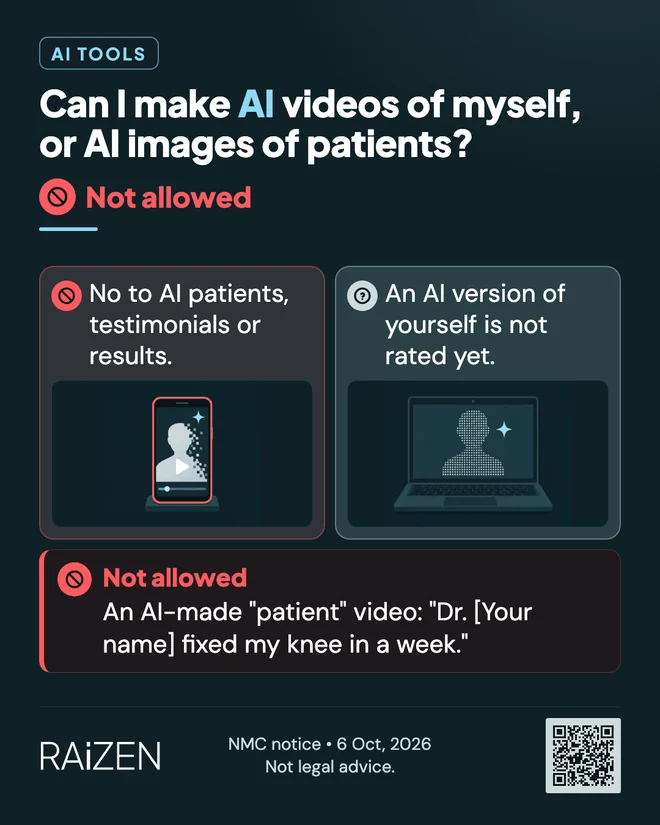
- The notice bars using AI to create or alter a patient's image, testimonial, voice or clinical outcome, or a synthetic endorsement passed off as a real patient, doctor or other person.
Risk scale
The example the rows refer to: An AI-made "patient" video: "Dr. [Your name] fixed my knee in a week."
The example above, or an AI-perfected X-ray in an ad.
Synthetic patients and altered outcomes are named in the clause.
RAiZEN's reading of clause 7.2(b)
Not rated yet: Very high risk, High risk, Medium risk, Low risk, Allowed.
The notice's exact words
7.Prohibited Advertising Practices for RMP / Clinical Establishments
b) AI shall not be used to create or manipulate a patient's image, testimonial, voice or clinical outcome, or to create a synthetic endorsement or representation purporting to be that of an actual patient, RMP or other person.
Next, read these
Social media and WhatsAppWhat must my posts show about me?
Every post: your name, qualifications, registration status and registration number.
What must my posts show about me?
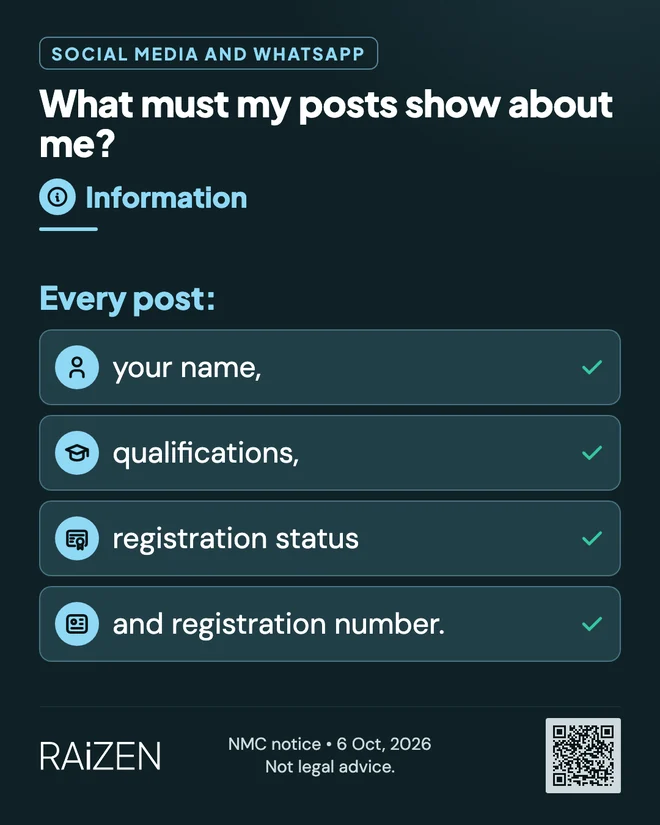
- The notice's definitions say a doctor publishing electronic media posts should disclose these.
- On RAiZEN's reading, a website page counts as such a post, so add them there too.
The notice's exact words
3.Definitions
Explanation III- RMP while publishing any Electronic media posts should transparently disclose their name, qualifications, registration status and SMR/NMR Registration number.
Next, read these
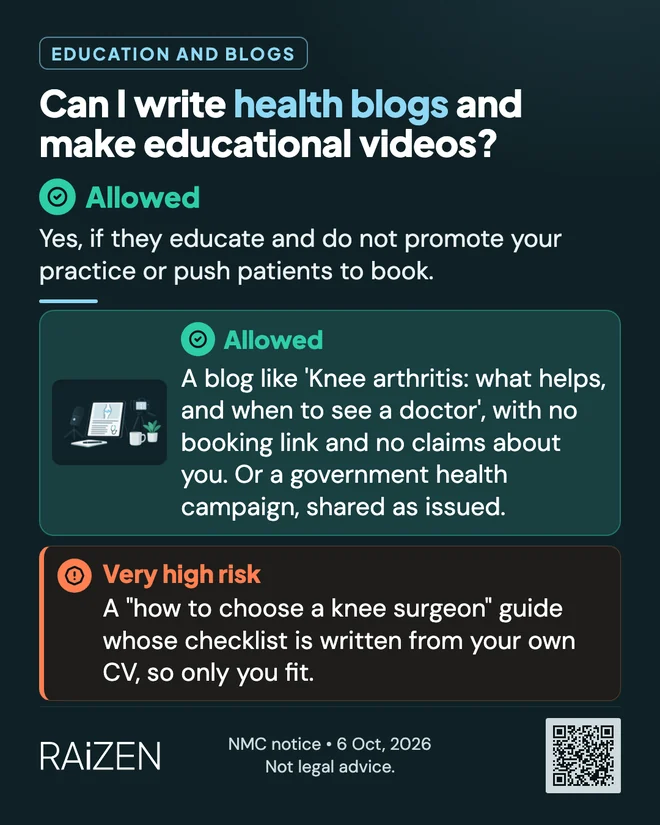
Education and blogsCan I write health blogs and make educational videos?
Yes, if they educate and do not promote your practice or push patients to book.
Can I write health blogs and make educational videos?
- The notice's public awareness rules allow educational content that does not promote your practice, solicit patients or earn through promotional marketing.
- Government health campaigns are exempt too, unless you add your own offer or booking line, on RAiZEN's reading.
- The scale shows how booking links change that.
Risk scale
The example the rows refer to: A blog by Dr. [Your name]: "Knee arthritis: what helps, and when to see a doctor."
A "how to choose a knee surgeon" guide whose checklist is written from your own CV, so only you fit.
An indirect "best". The notice reaches such claims "by whatsoever name called".
RAiZEN's reading of clause 8.1(iii)
The blog above, with "Book now" buttons in the body.
A booking push inside education makes it promotion.
RAiZEN's reading of clause 5.1
The blog above, ending with a plain link: "Clinic timings and how to book".
A quiet end link to a facts-only page. Keep the page it links to free of claims.
RAiZEN's reading
A blog like 'Knee arthritis: what helps, and when to see a doctor', with no booking link and no claims about you. Or a government health campaign, shared as issued.
Pure education, or a government campaign in the public interest. The notice allows both.
RAiZEN's reading of clause 5.1 and the Explanation to clause 7.3
Not rated yet: Not allowed, High risk.
The notice's exact words
5.Public Awareness: Public health education
5.1 Medical Practitioners may participate in health awareness programmers, public health campaigns, academic discussions, educational content, provided that such activities do not promote personal practice, do not solicit patients and are not monetized through promotional marketing.
7.Prohibited Advertising Practices for RMP / Clinical Establishments
7.3 The prohibited practices relating to advertising, publicity, solicitation, endorsements, testimonials, patient images, misleading claims and digital manipulation shall be governed by Chapter III of these Guidelines. RMPs and clinical establishments shall also comply with the specific requirements relating to patient privacy, digital communication and AI contained in pre-paras of this Chapter.
Explanation - All campaigns on programmes/schemes of Government of India and the state Governments, which arein larger public interest, shall be exempted from these guidelines.
8.1 Advertising Restrictions and Permitted Communications for RMPs.
iii. Shall not advertise either personal achievements or professional success rates or number of patients treated with illustrative assertions such as
or any other unverifiable or exaggerated claims by whatsoever name called.
Next, read these
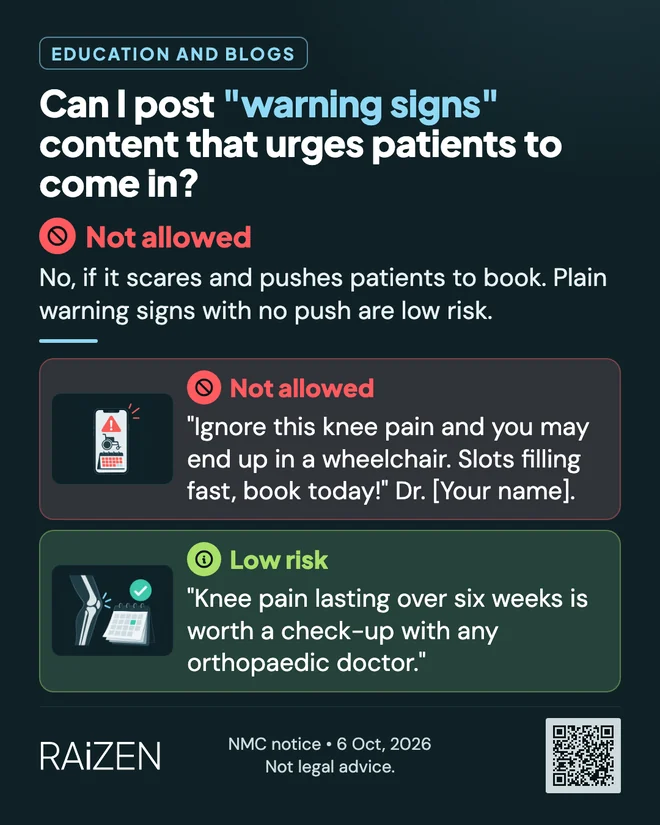
Education and blogsCan I post "warning signs" content that urges patients to come in?
No, if it scares and pushes patients to book. Plain warning signs with no push are low risk.
Can I post "warning signs" content that urges patients to come in?
- The notice's rules for doctors bar fear-based marketing and advertising meant to create unnecessary demand for procedures or tests.
Risk scale
The example the rows refer to: "Ignore this knee pain and you may end up in a wheelchair. Slots filling fast, book today!" Dr. [Your name].
The example above.
Fear plus urgency plus a booking call is the fear-based marketing the notice names.
The notice's own words, clause 8.1(i)
"Most knee pain ends in replacement. Get your MRI done now."
Pushes a test and a procedure the reader may not need.
RAiZEN's reading of clause 8.1(i)
"Knee pain lasting over six weeks is worth a check-up with any orthopaedic doctor."
A warning sign with no push towards you. Keep it general.
RAiZEN's reading of clauses 5.1 and 8.1(i)
Not rated yet: High risk, Medium risk, Allowed.
The notice's exact words
5.Public Awareness: Public health education
5.1 Medical Practitioners may participate in health awareness programmers, public health campaigns, academic discussions, educational content, provided that such activities do not promote personal practice, do not solicit patients and are not monetized through promotional marketing.
8.1 Advertising Restrictions and Permitted Communications for RMPs.
i. Shall not engage in advertisement/ activities intended to create unnecessary demand for medical procedures, promote unnecessary diagnostics and promote fear-based marketing.
Next, read these
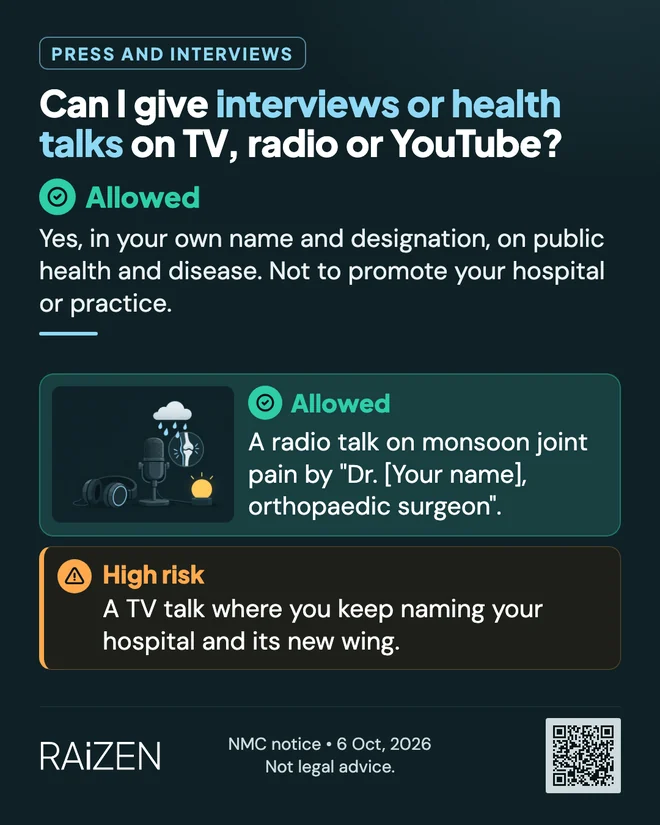
Press and interviewsCan I give interviews or health talks on TV, radio or YouTube?
Yes, in your own name and designation, on public health and disease. Not to promote your hospital or practice.
Can I give interviews or health talks on TV, radio or YouTube?
- The notice's exceptions for doctors allow lectures and talks on public health and diseases through TV, radio and electronic media, in your own name and designation, without promoting your employer.
Risk scale
The example the rows refer to: A radio talk on monsoon joint pain by "Dr. [Your name], orthopaedic surgeon".
A TV talk where you keep naming your hospital and its new wing.
The allowed route is a talk that does not promote your employer.
RAiZEN's reading of clause 8.2(iii)
The example above.
Public health, in your own name and designation. The notice allows it.
RAiZEN's reading of clause 8.2(iii)
Not rated yet: Not allowed, Very high risk, Medium risk, Low risk.
The notice's exact words
8.2 Exceptions from Prohibitions for RMP –
iii. Medical Practitioners may deliver lectures or talks on public health and diseases for public awareness through television, radio and electronic media in their own name and designation, without promoting their employer organization.
Next, read these
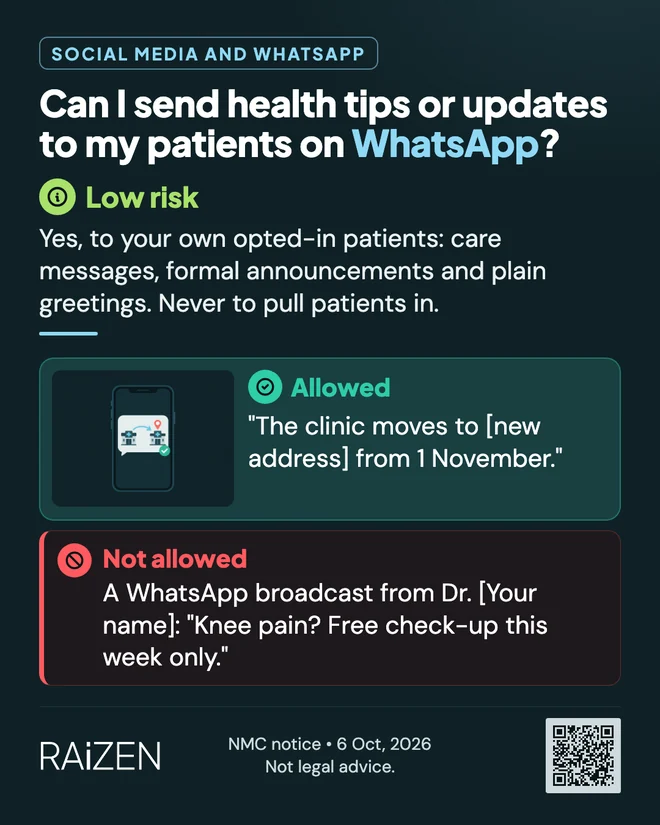
Social media and WhatsAppCan I send health tips or updates to my patients on WhatsApp?
Yes, to your own opted-in patients: care messages, formal announcements and plain greetings. Never to pull patients in.
Can I send health tips or updates to my patients on WhatsApp?
- The notice counts WhatsApp as a medium of advertising and asks doctors to use social media responsibly.
- It lists digital mass solicitation as a serious violation.
- Formal announcements, such as a change of address, are allowed.
Risk scale
The example the rows refer to: A WhatsApp broadcast from Dr. [Your name]: "Knee pain? Free check-up this week only."
The example above, sent to bought phone lists.
An offer blasted to strangers is the digital mass solicitation the notice lists as serious.
The notice's own words, clause 10.1(iv)
A message to your own patients who opted in: "Do your knee exercises twice a day."
A care message to people already in your care.
RAiZEN's reading
"The clinic moves to [new address] from 1 November."
A formal announcement of a change of address. The notice allows it.
The notice's own words, clause 8.2(ii)
Not rated yet: Very high risk, High risk, Medium risk.
The notice's exact words
3.Definitions
3.5 “Medium of advertisement” means and includes but is not limited to print media, Television, Radio, Social media platforms, websites and blogs, messaging platforms (WhatsApp, Telegrams, Facebook etc.),Podcasts, Influencer marketing, Digital marketing campaigns, sponsored posts, artificial intelligence generated promotion, public interviews, news articles intended for promotion, online healthcare platforms, any audio-visual or digital communication by whatsoever name called.
7.Prohibited Advertising Practices for RMP / Clinical Establishments
7.1 RMP/ Clinical Establishments should use the social media in the most responsible manner and with the sole intention to balance public dissemination of information with utmost enforcement of patient integrity along with stringent adherence to professional ethics.
8.2 Exceptions from Prohibitions for RMP –
ii. A medical practitioner is however permitted to make a formal announcement regarding the following :
a) On starting practice.
b) On change of type of practice.
c) On changing address.
d) On temporary absence from duty.
e) On resumption of another practice.
f) On succeeding to another practice.
g) Public declaration of charge.
10.Penalties / Corrective Measures
iv. Serious Violation (Misleading cure claims, inducement for patients, digital mass solicitation, etc.) Suspension of 6-12 months.
Next, read these
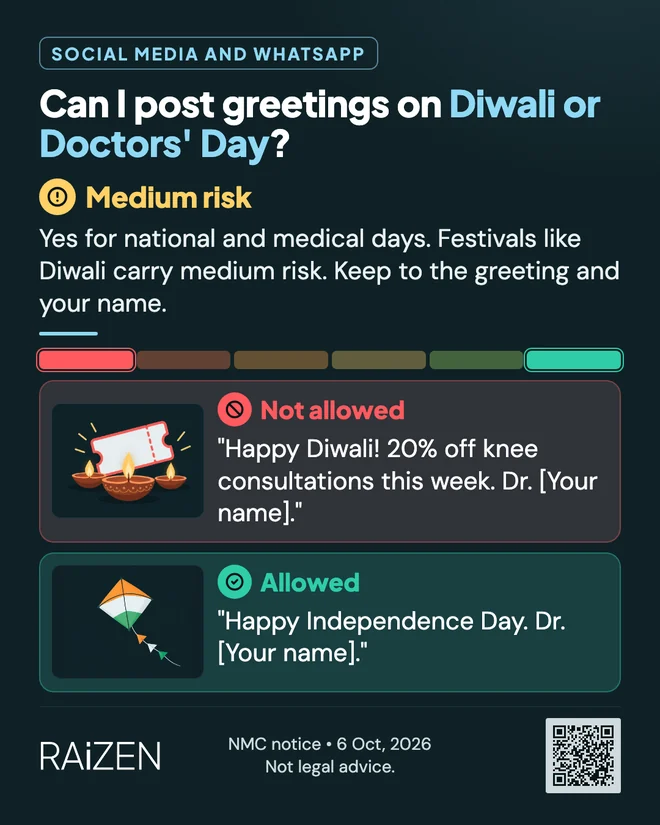
Social media and WhatsAppCan I post greetings on Diwali or Doctors' Day?
Yes for national and medical days. Festivals like Diwali carry medium risk. Keep to the greeting and your name.
Can I post greetings on Diwali or Doctors' Day?
- The notice's exceptions for doctors allow greetings on days of national importance or related to the medical profession, without advertising professional gains.
- Festivals are not named, so they sit a step higher on RAiZEN's reading.
Risk scale
The example the rows refer to: "Happy Diwali! 20% off knee consultations this week. Dr. [Your name]."
The example above: a greeting carrying an offer.
An offer used to pull patients in is an inducement, which the notice lists as serious.
RAiZEN's reading of clauses 8.1(x) and 10.1(iv)
"Happy Diwali. Dr. [Your name]." With or without your photo.
Festivals are not named in the notice's greeting exception, and a photo adds promotion.
RAiZEN's reading
"Happy Independence Day. Dr. [Your name]."
A national day greeting with just your name. The notice allows it.
The notice's own words, clause 8.2(v)
Not rated yet: Very high risk, High risk, Low risk.
The notice's exact words
8.1 Advertising Restrictions and Permitted Communications for RMPs.
x. No RMP or hospital/medical institution shall use discounts, limited-period offers, contests, coupons, gifts, cashbacks, referral benefits, free procedures or similar inducements in a manner that is likely to encourage unnecessary medical consultation, diagnostic investigation or treatment or otherwise amounts to solicitation of patients.
Any lawful disclosure of charges, packages or fees shall be factual, transparent and not misleading.
8.2 Exceptions from Prohibitions for RMP –
v. Greeting on days of national importance or related to medical profession, etc. of National Day, etc. can be given by Medical Practitioners, however same should not contain advertisement of a professional gains.
10.Penalties / Corrective Measures
iv. Serious Violation (Misleading cure claims, inducement for patients, digital mass solicitation, etc.) Suspension of 6-12 months.
Next, read these
Agencies and paid promotionCan I hire a marketing or social media agency?
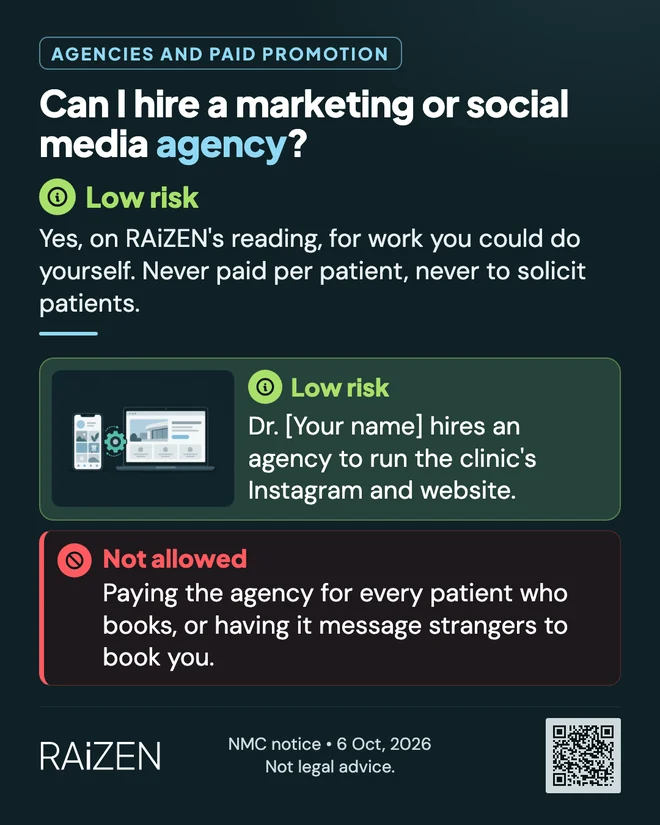
Yes, on RAiZEN's reading, for work you could do yourself. Never paid per patient, never to solicit patients.
Can I hire a marketing or social media agency?
- The notice's rules for doctors say a doctor shall not "engage any third party for marketing medical services"; on RAiZEN's reading, that does not bar help with work you could do yourself.
- An agency must never be paid in a way linked to the patients it brings, or do for you what you cannot do directly.
- RAiZEN is a marketing practice; this is our reading, and you should know that.
Risk scale
The example the rows refer to: Dr. [Your name] hires an agency to run the clinic's Instagram and website.
Paying the agency for every patient who books, or having it message strangers to book you.
Payment linked to each patient, and soliciting patients, are both barred.
RAiZEN's reading of clauses 8.1(ii) and 8.1(viii)
The example above, with you approving every post before it goes live.
Work you could do yourself, with your sign-off. You stay responsible for what goes out.
RAiZEN's reading of clauses 8.1(ii) and 4.4
Not rated yet: Very high risk, High risk, Medium risk, Allowed.
The notice's exact words
8.1 Advertising Restrictions and Permitted Communications for RMPs.
ii. Shall not solicit patients directly or indirectly, promote his/her professional services through self-promotion, engage any third party for marketing medical services, permit the use of their name, image, voice, testimonial or endorsement for promotion of services or any products, participate in promotional campaigns giving an impression of commercialization of medical practice.
viii. The engagement of advertising agencies, digital marketing agencies, influencers or online platforms shall not be structured in a manner that results in payment or consideration being linked to the procurement or referral of individual patients.
xi. No RMP shall use or permit any celebrity, influencer, patient, employee or third party to promote professional services through prohibited testimonials, endorsements or recommendations. Any material commercial relationship in lawful public-health or informational communication shall be transparently disclosed in accordance with applicable law. No RMP or hospital/medical institution shall use a third party as an intermediary to do indirectly what the RMP or institution is prohibited from doing directly.
Next, read these
Agencies and paid promotionWho is responsible for what my agency or hospital posts?
You are, for anything you authorised, commissioned, sponsored, adopted or knowingly permitted.
Who is responsible for what my agency or hospital posts?
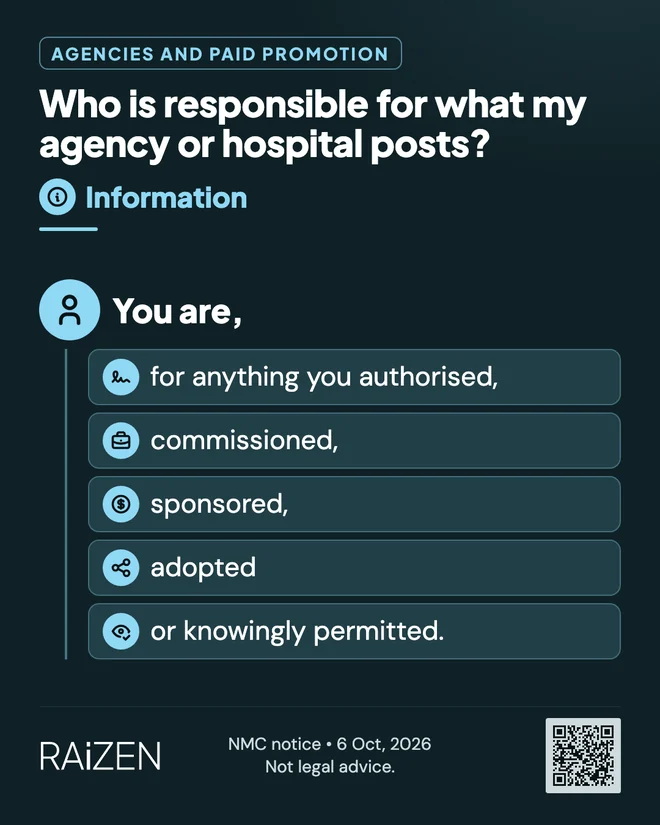
- The notice's scope says publishing through an agency, influencer or platform does not by itself free you of responsibility for content you authorised, commissioned, sponsored, adopted or knowingly permitted.
- Your hospital's own ads fall under state clinical-establishments law; where you personally authorised, took part in or endorsed one, your own conduct can be examined separately.
- The competent authority decides the consequences.
The notice's exact words
4.Scope & Applicability
4.4 The fact that an advertisement or promotional communication is published through a digital platform, third party, advertising agency, influencer or other intermediary shall not, by itself, absolve an RMP or medical institution from responsibility for content which it has authorized, commissioned, sponsored, adopted or knowingly permitted. The disciplinary or statutory consequences shall, however, be determined by the competent authority under the applicable law.
11.Appellate Mechanism
11.5 In case of any violation by a hospital or medical institution, the corresponding penalty and appellate mechanism, in accordance with the Clinical Establishments Act and the Rules framed thereunder/ any other State Act as applicable, shall apply. Where an RMP has personally authorized, participated in, endorsed or otherwise been responsible for the prohibited communication, the professional conduct of such RMP may separately be examined by the concerned State Medical Council, Ethics and Medical Registration Board or National Medical Commission, as applicable.
Next, read these
Agencies and paid promotionCan my agency use SEO or ads to rank me higher on Google?
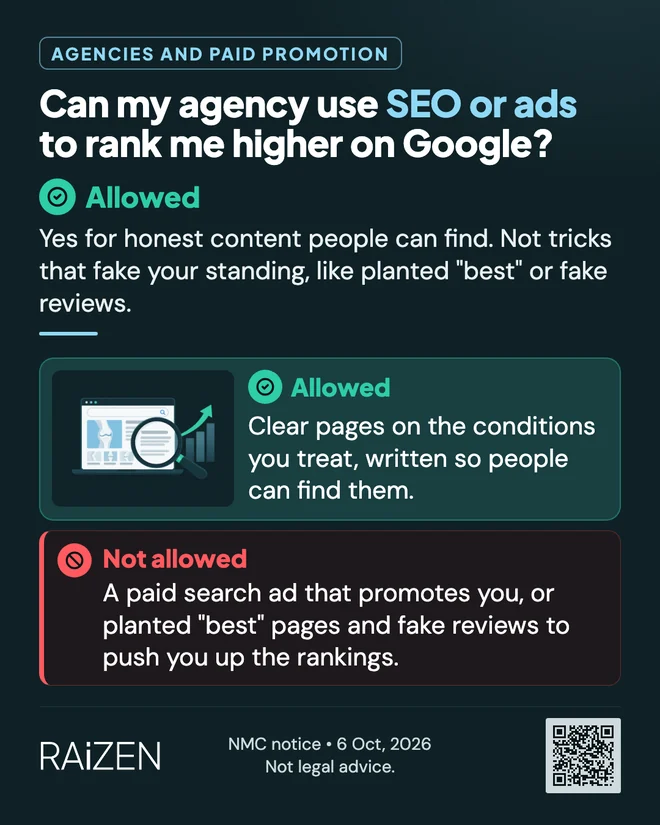
Yes for honest content people can find. Not tricks that fake your standing, like planted "best" or fake reviews.
Can my agency use SEO or ads to rank me higher on Google?
- The notice's rules for doctors bar manipulating "search rankings, visibility or algorithms to create a misleading impression of professional standing", and its definitions treat sponsored and search-engine promotion as advertising.
- On RAiZEN's reading, paid ads that promote you are not allowed, while organic search is, if every word on your pages stays within this notice.
- RAiZEN is a marketing practice; this is our reading, and you should know that.
Risk scale
The example the rows refer to: An agency promises Dr. [Your name] the top spot on Google for "knee surgeon near me".
A paid search ad that promotes you, or planted "best" pages and fake reviews to push you up the rankings.
Ads promote you, and manipulating rankings is named in clause 8.1(xii). RAiZEN reads both as not allowed.
RAiZEN's reading of clauses 3.2, 8.1(ii) and 8.1(xii)
Clear pages on the conditions you treat, written so people can find them.
Honest content that search engines can read. Keep every word within this notice.
No rule covers it (RAiZEN's reading)
Not rated yet: Very high risk, High risk, Medium risk, Low risk.
The notice's exact words
3.Definitions
For the purposes of these Guidelines, digital, social-media, sponsored, targeted, influencer-led, search-engine, platform-based, audio-visual, AI-generated or AI-assisted promotional communications shall be treated as advertising where their content or manner of dissemination has a promotional character.
8.1 Advertising Restrictions and Permitted Communications for RMPs.
xii. No RMP or hospital/medical institution shall procure, manipulate or cause any third party to procure or manipulate fake followers, likes, reviews, ratings, testimonials, comments, views or other digital engagement, or manipulate search rankings, visibility or algorithms to create a misleading impression of professional standing.
Next, read these
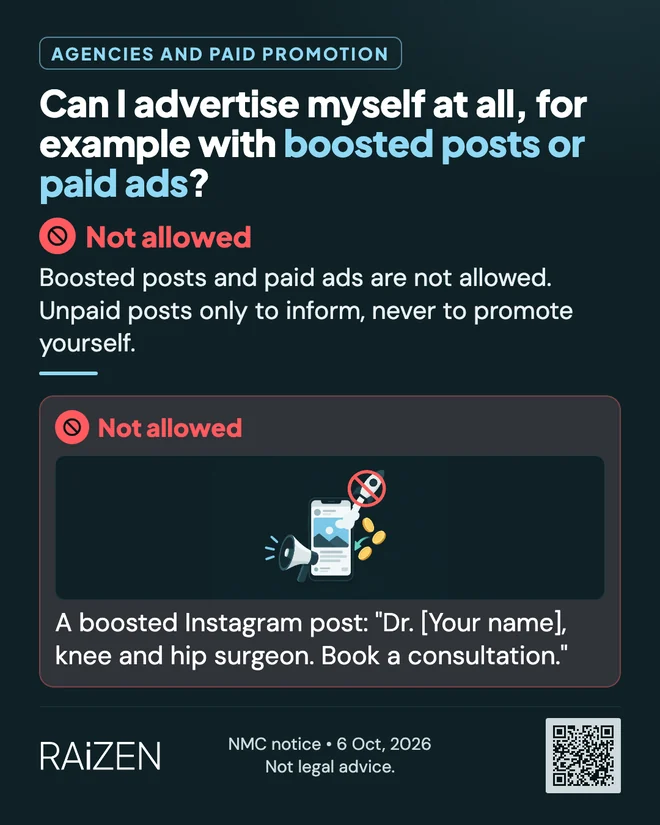
Agencies and paid promotionCan I advertise myself at all, for example with boosted posts or paid ads?
Boosted posts and paid ads are not allowed. Unpaid posts only to inform, never to promote yourself.
Can I advertise myself at all, for example with boosted posts or paid ads?
- The notice's rules for doctors say a doctor shall not solicit patients directly or indirectly, or promote their services through self-promotion.
- The definitions treat sponsored and targeted posts as advertising.
- RAiZEN is a marketing practice; this is our reading, and you should know that.
Risk scale
The example the rows refer to: A boosted Instagram post: "Dr. [Your name], knee and hip surgeon. Book a consultation."
The example above, or a paid ad for your clinic.
Paying to push your own promotion to strangers. RAiZEN reads this as not allowed.
RAiZEN's reading of clauses 3.2 and 8.1(ii)
Not rated yet: Very high risk, High risk, Medium risk, Low risk, Allowed.
The notice's exact words
3.Definitions
For the purposes of these Guidelines, digital, social-media, sponsored, targeted, influencer-led, search-engine, platform-based, audio-visual, AI-generated or AI-assisted promotional communications shall be treated as advertising where their content or manner of dissemination has a promotional character.
3.5 “Medium of advertisement” means and includes but is not limited to print media, Television, Radio, Social media platforms, websites and blogs, messaging platforms (WhatsApp, Telegrams, Facebook etc.),Podcasts, Influencer marketing, Digital marketing campaigns, sponsored posts, artificial intelligence generated promotion, public interviews, news articles intended for promotion, online healthcare platforms, any audio-visual or digital communication by whatsoever name called.
8.1 Advertising Restrictions and Permitted Communications for RMPs.
ii. Shall not solicit patients directly or indirectly, promote his/her professional services through self-promotion, engage any third party for marketing medical services, permit the use of their name, image, voice, testimonial or endorsement for promotion of services or any products, participate in promotional campaigns giving an impression of commercialization of medical practice.
Next, read these
Social media and WhatsAppCan I buy followers, likes or reviews?
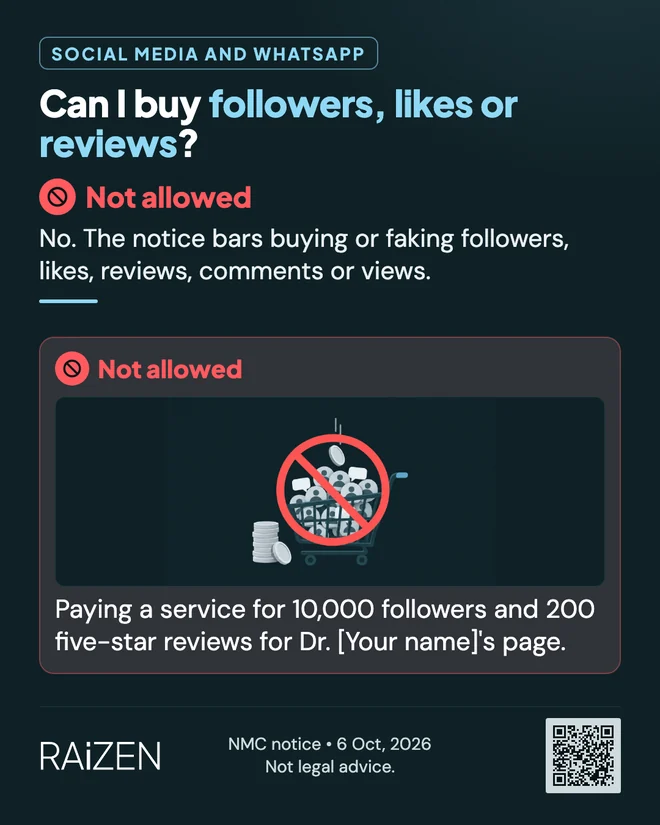
No. The notice bars buying or faking followers, likes, reviews, comments or views.
Can I buy followers, likes or reviews?
- The notice's rules for doctors bar procuring or manipulating fake followers, likes, reviews, ratings, comments, views or other engagement.
- Paid and fake patient reviews are barred too.
Risk scale
The example the rows refer to: Paying a service for 10,000 followers and 200 five-star reviews for Dr. [Your name]'s page.
The example above, or asking staff to post reviews as if they were patients.
Both are named in the notice, word for word.
RAiZEN's reading of clause 8.1(xii) and Explanation V
Not rated yet: Very high risk, High risk, Medium risk, Low risk, Allowed.
The notice's exact words
3.Definitions
Explanation V- No RMP or hospital/medical institution shall solicit, purchase, procure, manipulate or cause to be published fake, paid or misleading patient reviews, ratings, testimonials, endorsements or recommendations for the promotion of medical services. An RMP shall not request or share patient testimonials, recommendations, endorsements or reviews for professional promotion on social media.
8.1 Advertising Restrictions and Permitted Communications for RMPs.
xii. No RMP or hospital/medical institution shall procure, manipulate or cause any third party to procure or manipulate fake followers, likes, reviews, ratings, testimonials, comments, views or other digital engagement, or manipulate search rankings, visibility or algorithms to create a misleading impression of professional standing.
Next, read these
Fees and offersCan I pay or take a fee for referring patients?
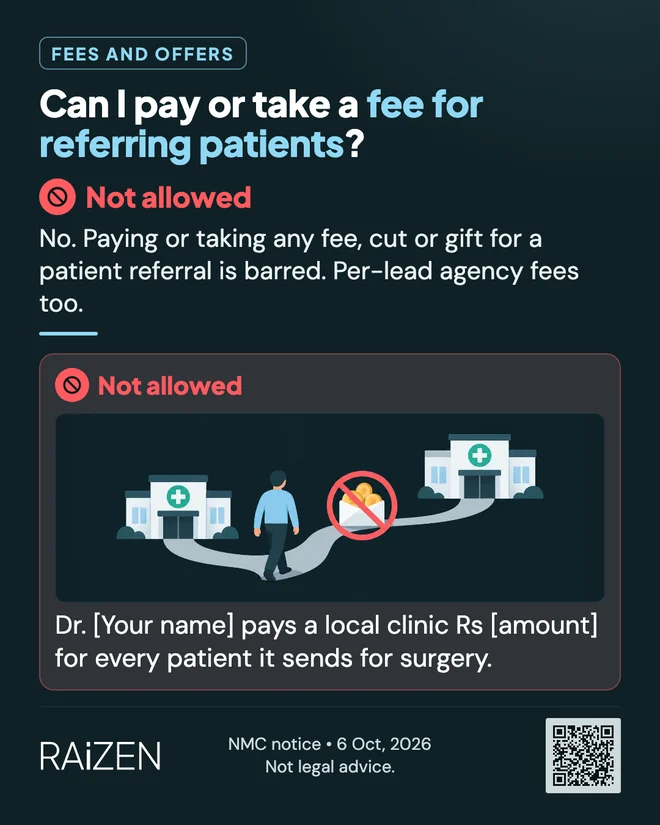
No. Paying or taking any fee, cut or gift for a patient referral is barred. Per-lead agency fees too.
Can I pay or take a fee for referring patients?
- The notice's rules for doctors bar offering, paying, soliciting or receiving any commission, rebate, gift, referral fee or lead-generation fee connected with referring or procuring patients.
Risk scale
The example the rows refer to: Dr. [Your name] pays a local clinic Rs [amount] for every patient it sends for surgery.
The example above, or a lab paying you for every test you order.
Referral fees and commissions are named in the clause.
RAiZEN's reading of clause 8.1(vii)
Not rated yet: Very high risk, High risk, Medium risk, Low risk, Allowed.
The notice's exact words
8.1 Advertising Restrictions and Permitted Communications for RMPs.
vii. No RMP shall, directly or indirectly, offer, pay, solicit, receive or participate in any commission, rebate, bonus, gift, gratuity, referral fee, lead-generation fee or other consideration in relation to the promotion or advertisement of medical services, where such consideration is connected with the referral, recommendation or procurement of patients, specimens or materials for diagnosis, treatment, surgery or other medical services.
Next, read these
Numbers and resultsCan I show numbers like "18,000+ surgeries" on my website?
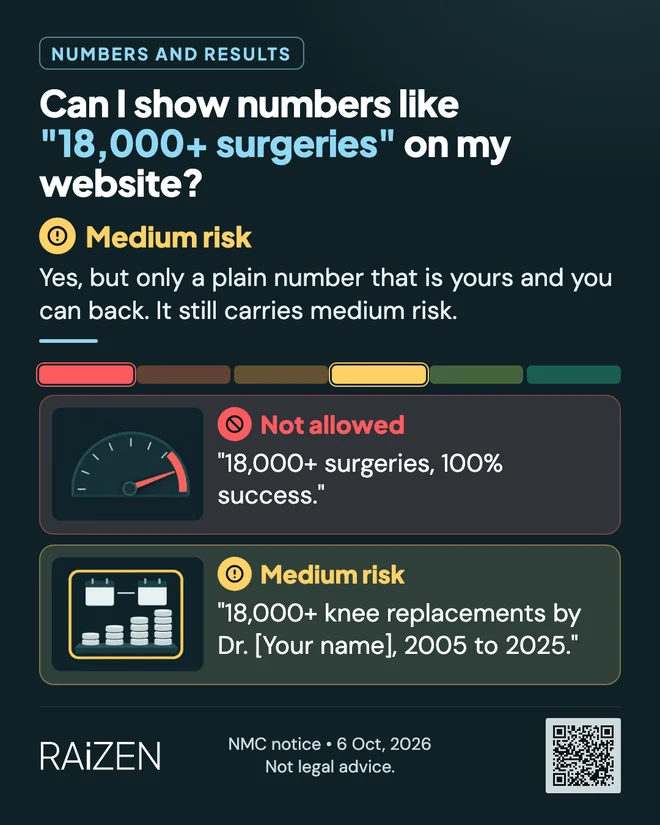
Yes, but only a plain number that is yours and you can back. It still carries medium risk.
Can I show numbers like "18,000+ surgeries" on my website?
- The notice's rules for doctors bar advertising the number of patients treated with claims like "100% success".
- A plain number with no such claim is a medium risk on RAiZEN's reading.
Risk scale
The example the rows refer to: "Dr. [Your name] has done 18,000+ knee replacements."
"18,000+ surgeries, 100% success."
The notice bans "100% success" word for word.
The notice's own words, clause 8.1(iii)
"18,000+ successful knee replacements."
A success word turns a count into a promise of results.
RAiZEN's reading
"18,000+ knee replacements, the most in Delhi", with who counted, how and when shown.
"The most" follows the same rule as "best": checkable only, and untested.
RAiZEN's reading
"18,000+ knee replacements by Dr. [Your name], 2005 to 2025."
Plain, yours and dated. Keep a written note of where it comes from: your logbook or hospital records.
RAiZEN's reading
Not rated yet: Low risk, Allowed.
The notice's exact words
8.1 Advertising Restrictions and Permitted Communications for RMPs.
iii. Shall not advertise either personal achievements or professional success rates or number of patients treated with illustrative assertions such as
or any other unverifiable or exaggerated claims by whatsoever name called.
Next, read these
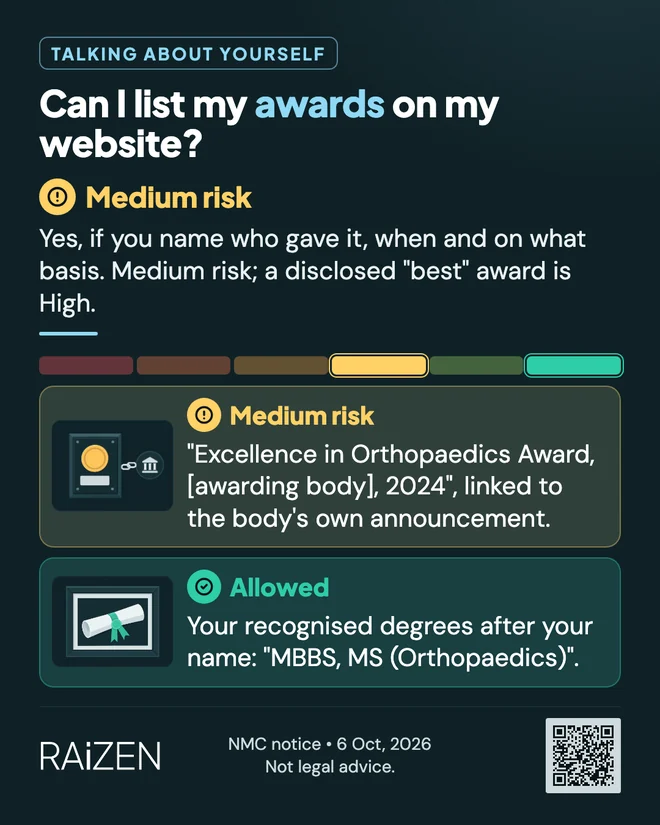
Talking about yourselfCan I list my awards on my website?
Yes, if you name who gave it, when and on what basis. Medium risk; a disclosed "best" award is High.
Can I list my awards on my website?
- The notice's rules for doctors bar advertising personal achievements with unverifiable claims.
- Any award you rely on must be checkable, with the awarding body, date and method disclosed where needed so the public is not misled.
Risk scale
The example the rows refer to: "Dr. [Your name], winner of the Excellence in Orthopaedics Award."
A "best" award with no awarding body, year or method. See Can I use the word "best" on my website?
A "best" award with who gave it, the year and the method. See Can I use the word "best" on my website?
"Excellence in Orthopaedics Award, [awarding body], 2024", linked to the body's own announcement.
Checkable and dated. The notice still bars advertising achievements, so it is not risk-free.
RAiZEN's reading of clauses 8.1(iii) and 8.1(ix)
Your recognised degrees after your name: "MBBS, MS (Orthopaedics)".
Qualifications are plain facts. The notice asks you to show them on your posts.
The notice's own words, Explanation III
Not rated yet: Not allowed, Low risk.
The notice's exact words
8.1 Advertising Restrictions and Permitted Communications for RMPs.
iii. Shall not advertise either personal achievements or professional success rates or number of patients treated with illustrative assertions such as
or any other unverifiable or exaggerated claims by whatsoever name called.
ix. No RMP or hospital/medical institution shall make comparative claims such as
or similar superiority claims unless the claim is objectively verifiable, based on a transparent and independently ascertainable methodology and is otherwise permissible under applicable law.
Provided, Any ranking or award relied upon in advertising shall be capable of independent verification, and material conditions, methodology and relevant date, details of award giving organization or firm shall be disclosed where necessary to avoid misleading the public.
Next, read these
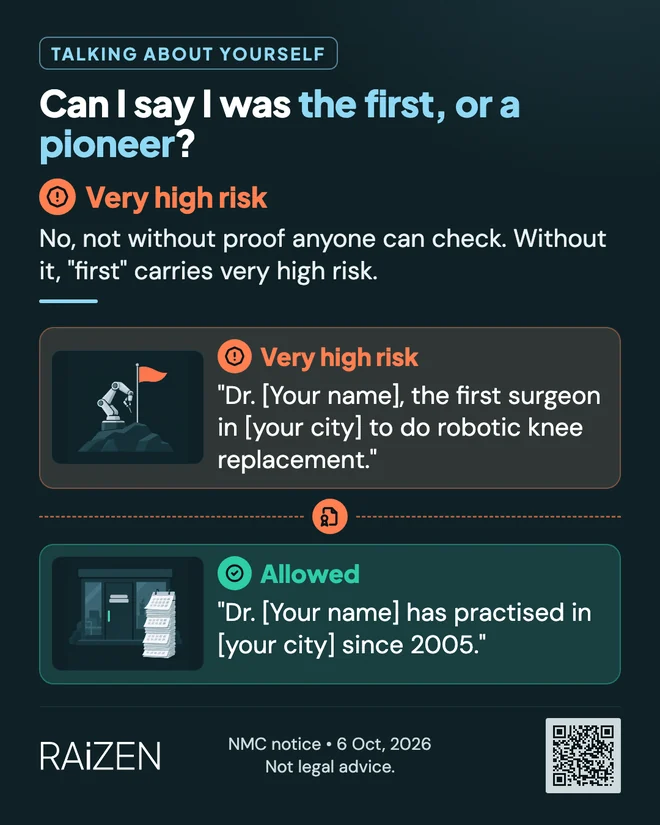
Talking about yourselfCan I say I was the first, or a pioneer?
No, not without proof anyone can check. Without it, "first" carries very high risk.
Can I say I was the first, or a pioneer?
- On RAiZEN's reading, "first" is a superiority claim under the notice's rules for doctors.
- It needs a method anyone can check, plus the awarding body, date and method where a ranking or award is relied on.
Risk scale
The example the rows refer to: "Dr. [Your name], the first surgeon in [your city] to do robotic knee replacement."
The example above, with no proof shown.
"First" says you beat everyone else to it. The notice wants that checkable, with the method shown.
RAiZEN's reading of clause 8.1(ix)
"A pioneer of keyhole hip surgery in India", with nothing to back it.
A pioneer claim with no proof reads as boasting.
RAiZEN's reading
"A pioneer of keyhole hip surgery", citing your first published paper on it.
Backed by your own published work, but still a claim about you.
RAiZEN's reading
"Dr. [Your name] has practised in [your city] since 2005."
A dated fact about your practice, with no "first" or "only".
No rule covers it (RAiZEN's reading)
Not rated yet: Not allowed, Low risk.
The notice's exact words
8.1 Advertising Restrictions and Permitted Communications for RMPs.
ix. No RMP or hospital/medical institution shall make comparative claims such as
or similar superiority claims unless the claim is objectively verifiable, based on a transparent and independently ascertainable methodology and is otherwise permissible under applicable law.
Provided, Any ranking or award relied upon in advertising shall be capable of independent verification, and material conditions, methodology and relevant date, details of award giving organization or firm shall be disclosed where necessary to avoid misleading the public.
Next, read these
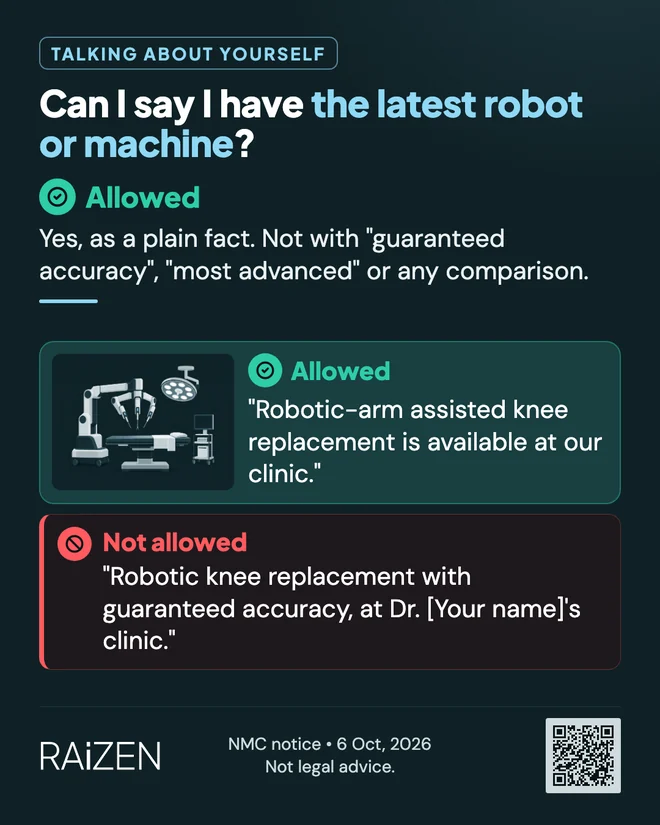
Talking about yourselfCan I say I have the latest robot or machine?
Yes, as a plain fact. Not with "guaranteed accuracy", "most advanced" or any comparison.
Can I say I have the latest robot or machine?
- The notice's definitions let you share that equipment or a service is available, as factual information.
- They bar claims of superiority, guaranteed accuracy, guaranteed outcomes or comparisons.
Risk scale
The example the rows refer to: "Robotic knee replacement with guaranteed accuracy, at Dr. [Your name]'s clinic."
The example above: "guaranteed accuracy".
The notice names guaranteed accuracy as a claim this kind of information must not carry.
The notice's own words, Explanation II
"The most advanced knee robot in [your city]."
A superiority claim. Nobody can check "most advanced".
RAiZEN's reading of Explanation II
Your hospital's video about its new robot, embedded on your page.
Technology news from the hospital. On your page it can read as promotion.
RAiZEN's reading
"Robotic-arm assisted knee replacement is available at our clinic."
A plain fact about a service. The notice allows exactly this.
RAiZEN's reading of Explanation II
Not rated yet: Very high risk, Low risk.
The notice's exact words
3.Definitions
Explanation II- Information regarding availability or installation of equipment, technology, diagnostic facilities or services may be disseminated as factual information, provided that such communication does not contain claims of superiority, guaranteed accuracy, guaranteed outcomes, comparative claims or other misleading or unverifiable representations.
Next, read these
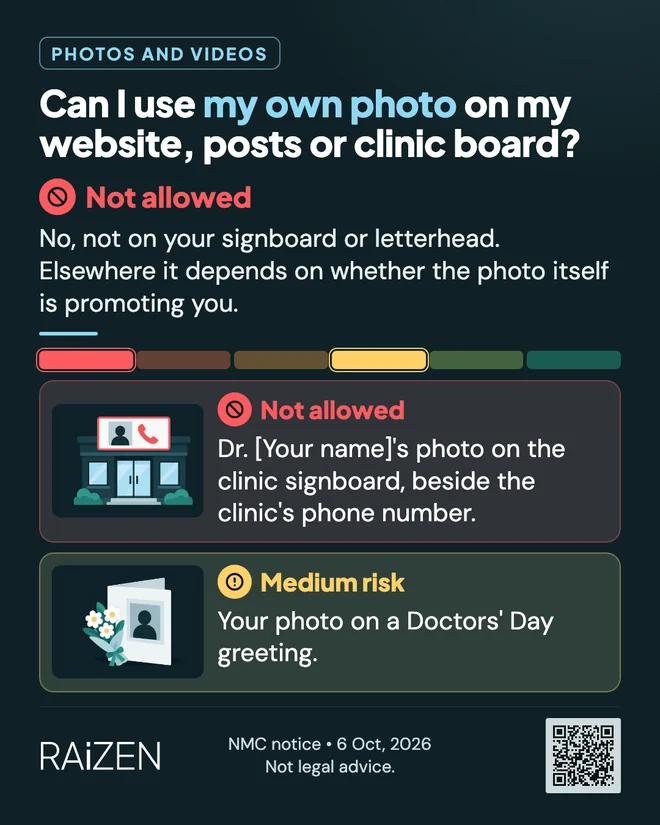
Photos and videosCan I use my own photo on my website, posts or clinic board?
No, not on your signboard or letterhead. Elsewhere it depends on whether the photo itself is promoting you.
Can I use my own photo on my website, posts or clinic board?
- The notice's rules do not permit a doctor's photo where it is self-advertisement or solicitation.
- A photo on a letterhead or signboard is named and called unethical conduct.
- A photo on your website's About page is not rated yet.
Risk scale
The example the rows refer to: Dr. [Your name]'s photo on the clinic signboard, beside the clinic's phone number.
The example above: your photo on your signboard or letterhead.
The notice names this and calls it unethical conduct.
RAiZEN's reading of clause 9.2
A press clipping on your website showing your photo and your clinic phone number.
Photo plus contact details turns a news item into an ad for you.
RAiZEN's reading of clause 9.2
Your photo on a Doctors' Day greeting.
A greeting is allowed. Your face on it starts to promote you.
RAiZEN's reading
Not rated yet: High risk, Low risk, Allowed.
The notice's exact words
9.Responsibilities of Hospital/Medical Institutions and RMP
9.2 Use of the photograph/image of an RMP shall not be permitted; where such use constitutes self-advertisement, solicitation or promotional publicity. In particular, use of self-photograph or similar publicity material on the letterhead or signboard of a consulting room or clinical establishment shall be governed by Regulations 6.1.1 and 6.1.2 of the Indian Medical Council (Professional Conduct, Etiquette and Ethics) Regulations, 2002, and regarded as unethical conduct.
Next, read these
Photos and videosCan I share patient photos or X-rays if I blur the face?
Yes, for teaching or science only, with documented consent. Blurring is not enough; remove every identifying detail.
Can I share patient photos or X-rays if I blur the face?
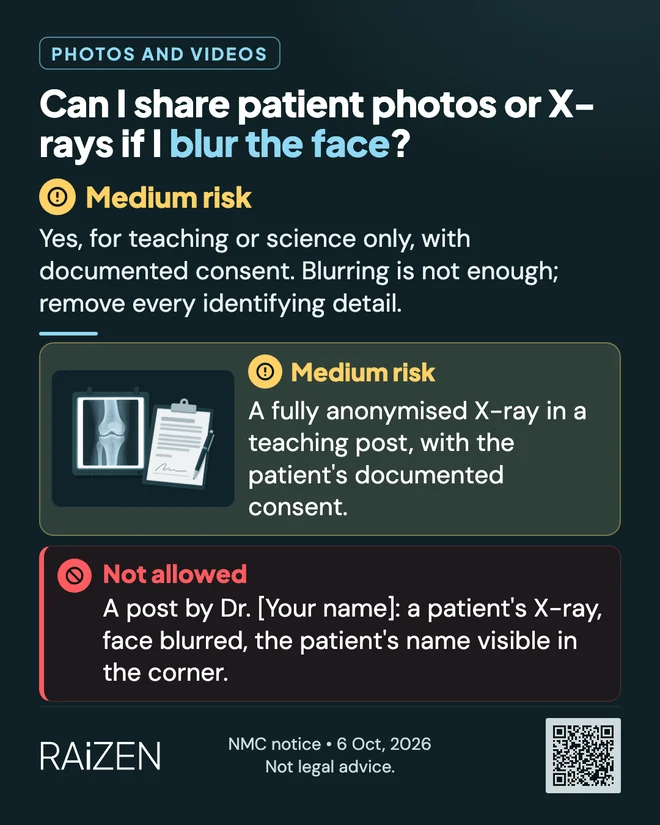
- The notice's rules for doctors bar publishing patient cases unless strictly for scientific or educational purposes, with anonymised patient consent.
- Its privacy rules also need consent that is specific, informed, voluntary, documented and checkable.
- Blurring the face is not enough: remove names, birthmarks and other identifying marks too.
Risk scale
The example the rows refer to: A post by Dr. [Your name]: a patient's X-ray, face blurred, the patient's name visible in the corner.
The example above: the patient's name visible on the X-ray.
Patient data that can identify someone publicly is named in the notice.
RAiZEN's reading of clause 7.4
A clinical photo with the face blurred but a tattoo showing.
The notice asks you to blur identifying marks too, not just the face.
RAiZEN's reading of clause 6.4
A fully anonymised X-ray in a teaching post, with the patient's documented consent.
Allowed in principle. Used to promote you, it falls under the stricter rules on cases and results.
RAiZEN's reading of clauses 6.1 and 8.1(v)
Not rated yet: High risk, Low risk, Allowed.
The notice's exact words
6.Patient Privacy and Consent
6.1 Patient information, photographs, videos, medical records, clinical images, treatment details, testimonials or other identifiable information shall not be used for advertising purposes except where such use is permitted by applicable law and the necessary consent and other safeguards have been duly complied with.
6.3 Where consent is legally required, it shall be specific, informed, voluntary, documented and capable of verification, and shall comply with applicable privacy and data-protection law. The form and mode of recording consent shall be determined in accordance with the applicable law and the nature and purpose of the proposed use.
6.4 Even where disclosure is lawfully permitted, reasonable safeguards shall be adopted by the hospital/medical institution and RMP shall be duty bound to prevent unnecessary disclosure of names or to crop, blur, black out, birth marks/ identification marks, or other information through which the patient may be identified.
7.Prohibited Advertising Practices for RMP / Clinical Establishments
7.4 RMP/ Clinical establishment shall not share any patient data, such as names, faces, anomalies, etc., which can be identified publicly.
8.1 Advertising Restrictions and Permitted Communications for RMPs.
v. Shall not publish cases for promotional purposes, advertise surgical results, display “before and after” photographs, publicize celebrity patients, promote personal success stories unless published strictly for scientific or educational purposes with anonymized patient consent.
Next, read these
Photos and videosCan I livestream or post videos of my surgeries?
No, not to promote yourself. Any live surgery broadcast must follow the NMC's separate rules for it.
Can I livestream or post videos of my surgeries?
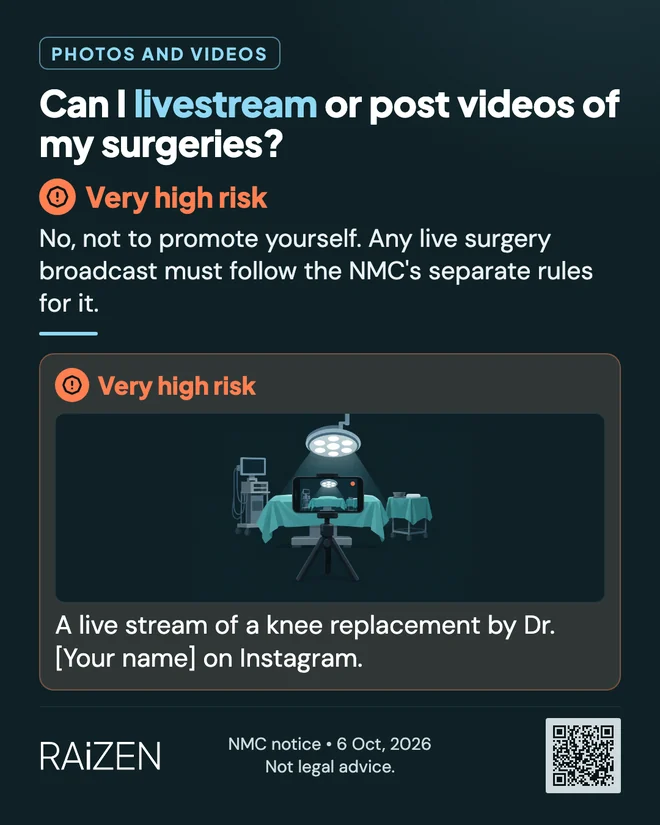
- The notice does not permit live broadcast or commercial dissemination of surgery outside the NMC's own live-surgery rules.
- Those rules cover patient safety, consent, privacy, educational purpose, sponsorship and commercialization.
Risk scale
The example the rows refer to: A live stream of a knee replacement by Dr. [Your name] on Instagram.
The example above, posted to draw patients.
Surgery shown for promotion is the commercial dissemination the clause rules out.
RAiZEN's reading of clause 7.5
Not rated yet: Not allowed, High risk, Medium risk, Low risk, Allowed.
The notice's exact words
7.Prohibited Advertising Practices for RMP / Clinical Establishments
7.5 Nothing in these Guidelines shall be construed as permitting the live broadcast or commercial dissemination of surgical or clinical procedures in a manner inconsistent with the applicable NMC guidelines, directions or advisories relating to live surgery broadcasts.
Any live surgery broadcast shall comply with the applicable NMC framework governing patient safety, consent, privacy, educational purpose, sponsorship, commercialization and professional conduct.
Next, read these
Fees and offersCan I put my fees and package prices online?
Yes. Fees and packages may be shown, if they are factual, clear and not misleading.
Can I put my fees and package prices online?
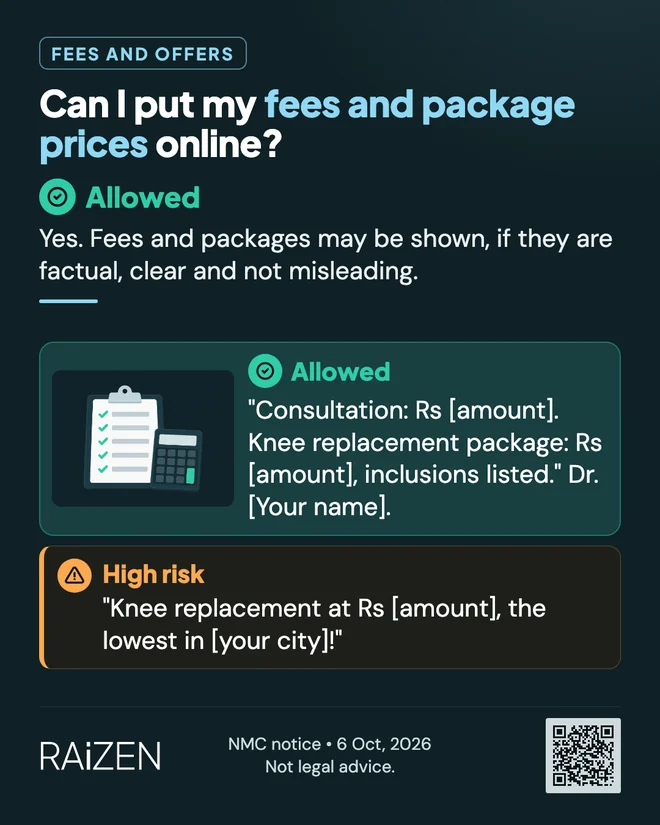
- The notice's rules for doctors say any disclosure of charges, packages or fees must be factual, transparent and not misleading.
- A public declaration of charges is an allowed announcement.
Risk scale
The example the rows refer to: "Consultation: Rs [amount]. Knee replacement package: Rs [amount], inclusions listed." Dr. [Your name].
"Knee replacement at Rs [amount], the lowest in [your city]!"
"Lowest" is a superiority claim nobody can check.
RAiZEN's reading of clause 8.1(ix)
"Knee replacement from Rs [amount]*", with the conditions in small print.
A "from" price with hidden conditions can mislead. Fees must not.
RAiZEN's reading of clause 8.1(x)
The example above: fees and inclusions stated plainly.
Factual and transparent, as the notice asks.
The notice's own words, clause 8.1(x)
Not rated yet: Not allowed, Very high risk, Low risk.
The notice's exact words
8.1 Advertising Restrictions and Permitted Communications for RMPs.
x. No RMP or hospital/medical institution shall use discounts, limited-period offers, contests, coupons, gifts, cashbacks, referral benefits, free procedures or similar inducements in a manner that is likely to encourage unnecessary medical consultation, diagnostic investigation or treatment or otherwise amounts to solicitation of patients.
Any lawful disclosure of charges, packages or fees shall be factual, transparent and not misleading.
8.2 Exceptions from Prohibitions for RMP –
ii. A medical practitioner is however permitted to make a formal announcement regarding the following :
a) On starting practice.
b) On change of type of practice.
c) On changing address.
d) On temporary absence from duty.
e) On resumption of another practice.
f) On succeeding to another practice.
g) Public declaration of charge.
9.Responsibilities of Hospital/Medical Institutions and RMP
9.3 RMP can issue a formal announcement which are factual, non-promotional and limited in scope regarding starting of practice, change of address, change of practice type, temporary absence, resumption of practice, public declaration of consultation fees.
Next, read these
Press and interviewsCan I put my press coverage on my website?
Yes, some of it. Each piece carries risk by what it says and whether it was paid for.
Can I put my press coverage on my website?
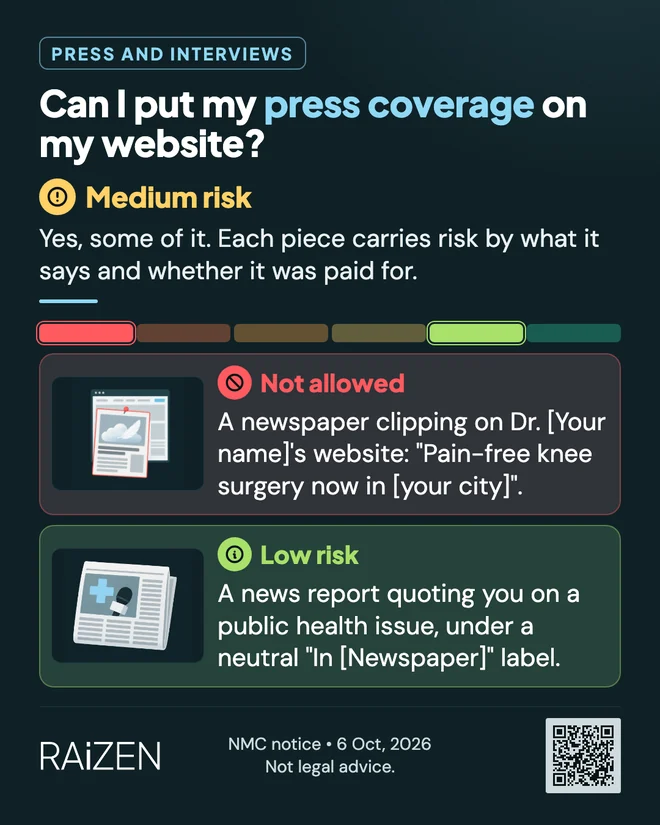
- The notice counts news articles intended for promotion as advertising and asks that paid relationships be disclosed.
- The scale below is RAiZEN's reading for press republished on a doctor's own site.
Risk scale
The example the rows refer to: A newspaper clipping on Dr. [Your name]'s website: "Pain-free knee surgery now in [your city]".
The example above: "pain-free" said of a treatment.
The notice names "painless treatment". On your site, the clipping carries it as your claim.
The notice's own words, clause 8.1(iii)
An implant maker's press release quoting you on its knee implant.
Your words tied to a named device read as endorsing it.
RAiZEN's reading of clause 8.1(iv)
A paid feature about you, otherwise clean, kept with the newspaper's own "Sponsored" label.
Paid promotion, shown honestly as paid.
RAiZEN's reading of clause 8.1(xi)
Your own interview in a newspaper about the treatments you do.
Your words on your treatments, republished by you.
RAiZEN's reading
A news report quoting you on a public health issue, under a neutral "In [Newspaper]" label.
Editorial reporting on public health, not about your practice.
RAiZEN's reading
Not rated yet: Allowed.
The notice's exact words
3.Definitions
3.5 “Medium of advertisement” means and includes but is not limited to print media, Television, Radio, Social media platforms, websites and blogs, messaging platforms (WhatsApp, Telegrams, Facebook etc.),Podcasts, Influencer marketing, Digital marketing campaigns, sponsored posts, artificial intelligence generated promotion, public interviews, news articles intended for promotion, online healthcare platforms, any audio-visual or digital communication by whatsoever name called.
8.1 Advertising Restrictions and Permitted Communications for RMPs.
iii. Shall not advertise either personal achievements or professional success rates or number of patients treated with illustrative assertions such as
or any other unverifiable or exaggerated claims by whatsoever name called.
iv. An RMP shall not give, directly or indirectly, any approval, recommendation, endorsement, certificate, report or statement concerning any drug, medicine, remedy, therapeutic article, apparatus, appliance, medical device, diagnostic product, health product or commercial product for use in advertising or publicity in connection with his/her name, signature, photograph, voice or professional status, whether or not monetary or other consideration is received.
xi. No RMP shall use or permit any celebrity, influencer, patient, employee or third party to promote professional services through prohibited testimonials, endorsements or recommendations. Any material commercial relationship in lawful public-health or informational communication shall be transparently disclosed in accordance with applicable law. No RMP or hospital/medical institution shall use a third party as an intermediary to do indirectly what the RMP or institution is prohibited from doing directly.
Next, read these
Endorsements and influencersCan I endorse a medicine, device or health product?
No. The notice bars endorsing any drug, device or health product in your name, paid or not.
Can I endorse a medicine, device or health product?
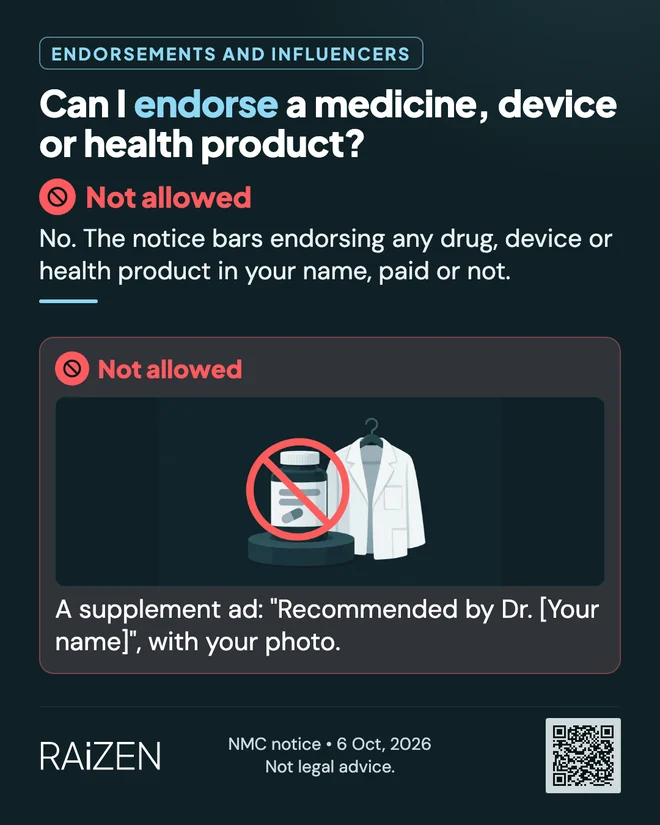
- The notice's rules for doctors bar any approval, recommendation or endorsement of a drug, device, diagnostic or health product for advertising, using your name, signature, photo, voice or professional status, whether or not you are paid.
Risk scale
The example the rows refer to: A supplement ad: "Recommended by Dr. [Your name]", with your photo.
The example above, or your own post praising a named implant brand.
Your name and photo selling a product. The clause names it.
The notice's own words, clause 8.1(iv)
Not rated yet: Very high risk, High risk, Medium risk, Low risk, Allowed.
The notice's exact words
8.1 Advertising Restrictions and Permitted Communications for RMPs.
ii. Shall not solicit patients directly or indirectly, promote his/her professional services through self-promotion, engage any third party for marketing medical services, permit the use of their name, image, voice, testimonial or endorsement for promotion of services or any products, participate in promotional campaigns giving an impression of commercialization of medical practice.
iv. An RMP shall not give, directly or indirectly, any approval, recommendation, endorsement, certificate, report or statement concerning any drug, medicine, remedy, therapeutic article, apparatus, appliance, medical device, diagnostic product, health product or commercial product for use in advertising or publicity in connection with his/her name, signature, photograph, voice or professional status, whether or not monetary or other consideration is received.
Next, read these
Endorsements and influencersCan an influencer, celebrity or famous patient promote me?
No. Nobody may promote you through testimonials or endorsements: not celebrities, influencers, patients or staff.
Can an influencer, celebrity or famous patient promote me?
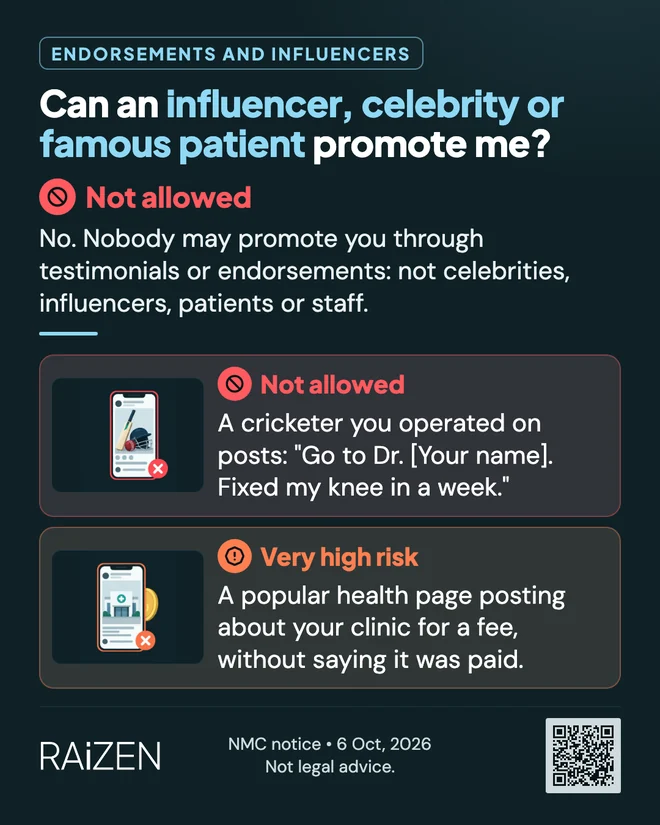
- The notice's rules for doctors bar letting anyone promote your services through prohibited testimonials or endorsements, and bar using a third party to do what you cannot do directly.
- Publicising celebrity patients is barred too.
Risk scale
The example the rows refer to: A cricketer you operated on posts: "Go to Dr. [Your name]. Fixed my knee in a week."
The example above, or a paid influencer reel about your clinic.
Celebrity and influencer testimonials are named in the clause.
RAiZEN's reading of clauses 8.1(v) and 8.1(xi)
A popular health page posting about your clinic for a fee, without saying it was paid.
A third party doing indirectly what you cannot, and a paid tie not disclosed.
RAiZEN's reading of clause 8.1(xi)
Not rated yet: High risk, Medium risk, Low risk, Allowed.
The notice's exact words
8.1 Advertising Restrictions and Permitted Communications for RMPs.
v. Shall not publish cases for promotional purposes, advertise surgical results, display “before and after” photographs, publicize celebrity patients, promote personal success stories unless published strictly for scientific or educational purposes with anonymized patient consent.
xi. No RMP shall use or permit any celebrity, influencer, patient, employee or third party to promote professional services through prohibited testimonials, endorsements or recommendations. Any material commercial relationship in lawful public-health or informational communication shall be transparently disclosed in accordance with applicable law. No RMP or hospital/medical institution shall use a third party as an intermediary to do indirectly what the RMP or institution is prohibited from doing directly.
Next, read these
Promises about resultsCan I promote a new treatment that is not yet proven?
No. The notice bars promoting unproven therapies and secret remedies, and any statement that hides the risks.
Can I promote a new treatment that is not yet proven?
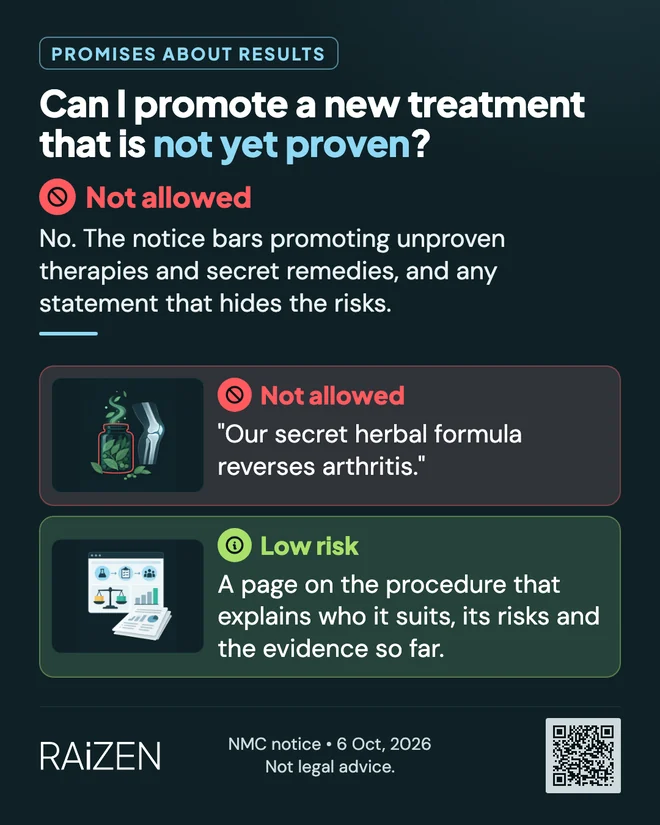
- The notice's rules for doctors bar promoting a therapy or secret remedy whose safety or efficacy is not adequately established.
- Statements that conceal risks are barred too.
Risk scale
The example the rows refer to: "Dr. [Your name]'s new injection regrows knee cartilage."
"Our secret herbal formula reverses arthritis."
A secret remedy is named in the clause.
RAiZEN's reading of clause 8.1(vi)
The example above, for an injection without established evidence.
Promoting a therapy whose efficacy is not established. Whether it is established is the judgement call.
RAiZEN's reading of clause 8.1(vi)
A page on a newer procedure that lists its benefits and leaves out its risks.
Leaving the risks out can read as concealing them.
RAiZEN's reading of clause 8.1(vi)
A page on the procedure that explains who it suits, its risks and the evidence so far.
Education with the risks shown. It still carries your name, so keep it free of claims.
RAiZEN's reading of clauses 5.1 and 8.1(vi)
Not rated yet: Medium risk, Allowed.
The notice's exact words
8.1 Advertising Restrictions and Permitted Communications for RMPs.
vi. Shall not publish any statement that creates unrealistic expectations, misrepresents treatment outcomes, conceals risks, promote unproven therapies, secret remedy or treatment whose composition, scientific basis, safety or efficacy is not adequately established or which is otherwise prohibited under applicable law.
Next, read these
Talking about yourselfCan I use hoardings, leaflets or brochures?
Yes, for plain facts only: your services, facilities and health information. No guarantees, no claims of being better.
Can I use hoardings, leaflets or brochures?
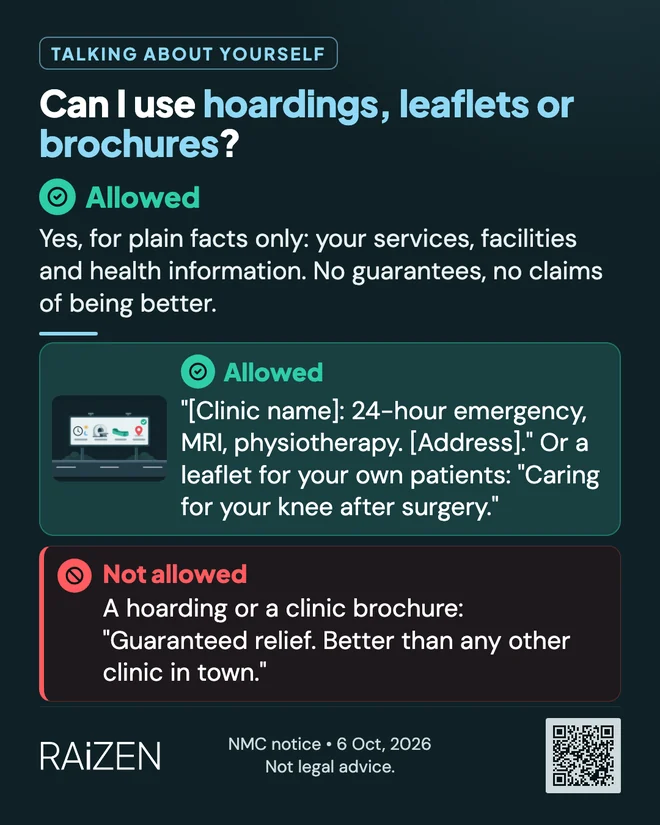
- The notice's public awareness rules let doctors use public hoardings only for factual information, such as infrastructure and facilities, and prohibit unverified or unverifiable claims on them.
- Its exceptions for doctors allow health-education pamphlets for patients visiting your clinic or hospital, without guarantees of cure, superiority or unsubstantiated claims.
Risk scale
The example the rows refer to: A highway hoarding: "Dr. [Your name]. Guaranteed relief from back pain."
A hoarding or a clinic brochure: "Guaranteed relief. Better than any other clinic in town."
An unverifiable claim on a hoarding is prohibited; guarantees and superiority are named as what pamphlets must not contain.
RAiZEN's reading of clauses 5.2, 8.1(iii) and 8.2(iv)
"[Clinic name]: 24-hour emergency, MRI, physiotherapy. [Address]." Or a leaflet for your own patients: "Caring for your knee after surgery."
Facilities and services stated as facts, and health education for your own patients. The notice allows both.
RAiZEN's reading of clauses 5.2 and 8.2(iv)
Not rated yet: Very high risk, High risk, Medium risk, Low risk.
The notice's exact words
5.Public Awareness: Public health education
5.2 Hoardings/Billboards in public space that are let out by concerned municipal or other authorities like state transport authority, railways, airports etc., may be used by hospitals/medical institutions and RMPs only for dissemination of factual information in the nature of infrastructure, facilities etc. Unverified or unverifiable claims shall be construed as for furtherance of commercial gains, and are prohibited.
8.1 Advertising Restrictions and Permitted Communications for RMPs.
iii. Shall not advertise either personal achievements or professional success rates or number of patients treated with illustrative assertions such as
or any other unverifiable or exaggerated claims by whatsoever name called.
8.2 Exceptions from Prohibitions for RMP –
iv. Medical Practitioners can issue health education and general information pamphlets/ brochures to the patients visiting their clinic/ hospital but these should not contain guarantee of cure or superiority over others or unsubstantiated claims or misleading information
Next, read these
Patients and reviewsWhat rules apply when I collect patient details online or put them into an AI tool?
India's data-protection and IT laws, and your duty of confidentiality. The notice adds no test of its own.
What rules apply when I collect patient details online or put them into an AI tool?
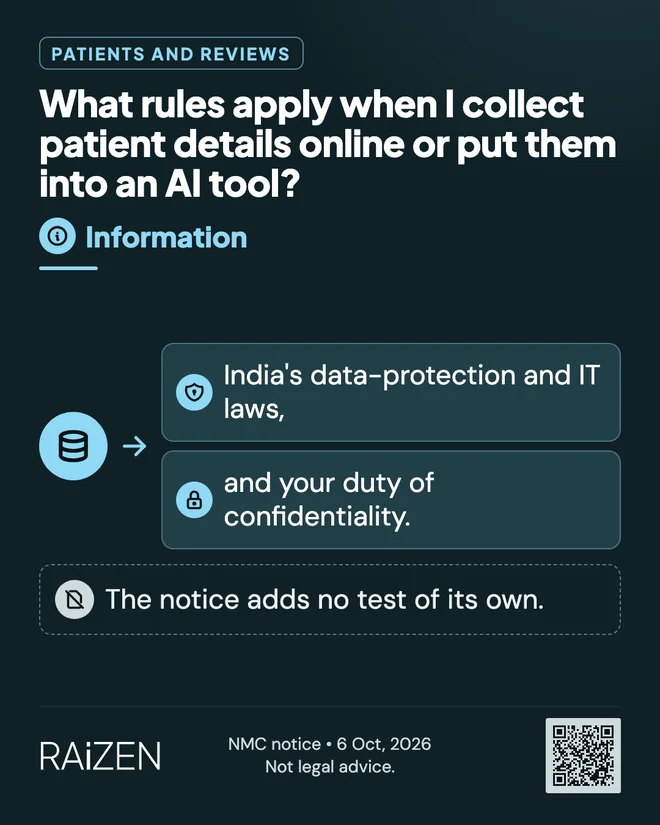
- The notice says advertising that uses personal data must follow the Information Technology Act, 2000 and the Digital Personal Data Protection Act, 2023 with its 2025 rules.
- Patient information used in an AI system must meet privacy, confidentiality, data-protection and ethics requirements.
The notice's exact words
7.Prohibited Advertising Practices for RMP / Clinical Establishments
d) Any use of patient information as input for an AI system shall comply with applicable privacy, confidentiality, data-protection and professional-ethics requirements.
7.6 Advertisement under these Guidelines involving processing, publication, storage, disclosure or other use of digital personal data shall comply with the provision of Information Technology Act, 2000; Digital Personal Data Protection Act, 2023 and Rules made thereunder in 2025, to the extent applicable and in force from time to time.
Next, read these
The basicsHow do I check my whole website against this notice?
Read each public page against every question in this FAQ. A page review cannot certify your site; some checks need your records.
How do I check my whole website against this notice?
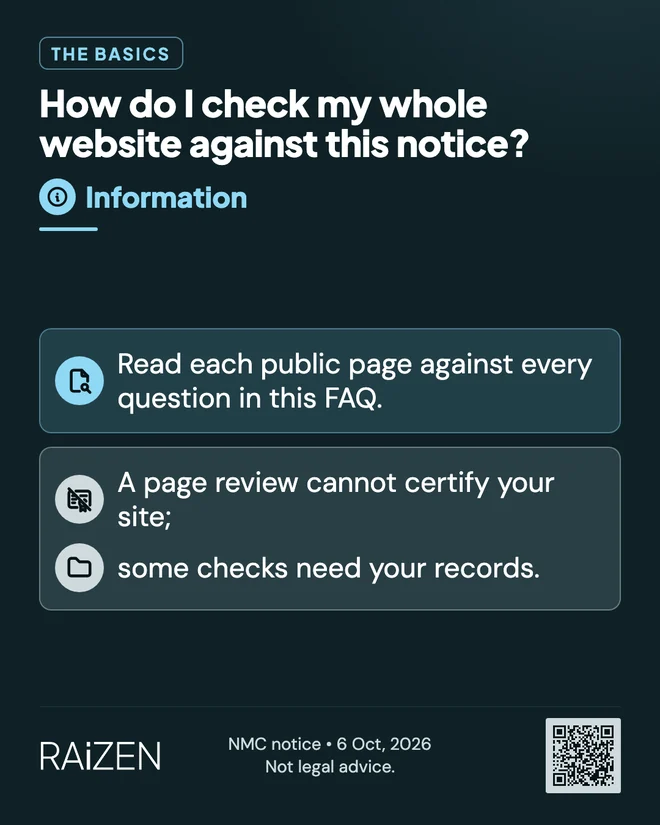
- This page reads the National Medical Commission's notice of 6 October 2026.
- A read of your public pages can check the words, photos, reviews, offers and registration details each page shows; matching those words to the risk levels below is RAiZEN's reading.
- It cannot check consent records, whether reviews were paid or faked, referral fees, agency payment terms, or the 2002 ethics code the notice is read with.
Each phrase has its own answer:
The notice's exact words
3.Definitions
3.2 "Advertisement” mean any form of communication, promotion, publicity, announcement, representation or dissemination of information in any medium, which directly or indirectly solicits, promotes or is intended to promote the professional services, reputation, skills, qualifications, achievements, facilities or commercial healthcare services of an RMP or hospital/medical institution.
4.Scope & Applicability
4.2 In relation to RMPs, these Guidelines shall be read with the IMC (Professional Conduct, Etiquette and Ethics) Regulations, 2002, as amended from time to time, and the NMC Act, 2019. In case of any irreconcilable conflict, the applicable statutory provisions and operative regulations shall prevail.
RAiZEN reads your public pages against this notice and tells you what it found. It does not certify compliance. To start, send just your website address, never patient records.
Next, read these
RAiZEN reads your public pages against this notice and tells you what it found. It does not certify compliance. To start, send just your website address, never patient records.